Friday, 22 November 2013

Momentous moments and memorials

Do you remember when...

The media is certainly making sure we do not overlook the 50th anniversary of the assassination of JFK. Footage of that fateful motorcade moment must have been replayed in the last few days almost as often as it was back in November 1963!  I was almost 11 back then, it was Saturday morning our time, and I was out shopping in Canberra city with my parents, when we met some friends of theirs, Mr and Mrs Levy, who told us the incredible news of what had just happened a few hours earlier. I think I even know what street corner we were stopped on. The previous year my primary school teacher Mr Harvey had given us lessons on the Cold War and the drama of the Cuban Missile crisis, and had instilled upon me at least the perilous state of the world in which JFK played such a dominant role. All the revelations since then have not diminished the drama or tragedy of what occurred.

There is actually a family history connection here. Arthur Augustus Calwell was the Leader of the Australian Labor Party prior to Gough Whitlam. He was also a first cousin of my husband's grandmother Grace. In July 1963 when Mr Calwell was Leader of the Opposition, he was granted an audience with the President in the Oval Office. Apparently during their meeting Mr Calwell told Mr Kennedy that his Calwell ancestors had left the States 100 years earlier in 1853, around the same time that Kennedy's ancestors had arrived there from Ireland, and Kennedy joked that he hoped it wasn't a case of cause and effect! Arthur Calwell was a keen family history researcher, and managed to get in touch with and meet some of his remaining American relatives during his American trip.

When Parliament met following the Presidential assassination a few months later, Calwell said, inter alia,  in an eloquent eulogy, that "A great and good man died and a generous and noble heart ceased to beat," when the US president "fell before an assassin's bullet". "When that death comes with the meaninglessness of assassination, then its sadness takes on a horror never to be obliterated from our memories."

It was ironic that on 21 June 1966 Calwell himself was to be the victim of an attempted assassination, when he was shot at point blank range when leaving a political meeting. The bullet was fortunately deflected by the car window and lodged in the lapel of Calwell's coat. He was slightly injured and spent the night in hospital. He subsequently wrote a letter of forgiveness to his attacker and continued on with his election campaign, but retired as leader of the ALP in January 1967, after suffering a substantial electoral defeat, and died in 1973.

The grave of Arthur Calwell and family at Melbourne General Cemetery
 I visited  the Kennedy monument at  the Arlington National Cemetery in 2005, and it is indeed a solemn place of reflection.
                         
On that same trip in 2005 we also visited New York, and during a wander through Central Park we came across Strawberry Fields, which is effectively a monument to John Lennon, who was murdered in his nearby apartment building on 8 December 1980, almost 33 years ago now. I don't remember exactly what I was doing that day, apart from the fact that as it was my sister-in-law's birthday we may have been helping her celebrate, but I know it was certainly a shock, and there was an outpouring of grief from all his fans and admirers world-wide, and a similar wave of sadness and  incredulity at how such a terribly tragic thing could possibly have occurred. The late great John Lennon, mourned for both his music and his work as a  peace activist.


Another death of an individual which resulted in world-wide mourning was of course that of Diana, Princess of Wales, 16 years ago, and it appears that the cause of her death is still in dispute. So much investigation, so many rumours, and yet no final resolution as to exactly what or how it happened! Diana was greatly admired by the general public for her grace and her humanity. The shrine created to Diana and Dodi in the stairwell of Harrods is tacky but somehow poignant at the same time. Is it still in place there, now that Mohamed al Fayed no longer owns the iconic store? Of course there are other monuments in Diana's memory, such as the attractive memorial fountain in Hyde Park, but I can't locate my own photograph of that either, so this one taken when we visited Harrods in December 1999 and the shrine will have to suffice. 


Probably the momentous event to which I've personally been closest was in Canberra, our national capital,  on 11 November 1975, when the Australian Governor General saw fit to dismiss the Labor Prime Minister Gough Whitlam, only three years after he became leader, and to appoint the leader of the Opposition in his place, pending a general election, which Labor was to lose.  To see a memorable photograph from that day, taken on the steps of what was then Parliament House click  here.  This was effectively a bloodless coup. It was unbelievable that such a thing could have happened, and was to have huge repercussions for  Australian politics. Gough believed he would be re-elected by the Australian people who would see the injustice of what had occurred, but it was not to be. I was in the middle of studying for my final law exams, only three or four kilometres away in a nearby suburb, where we were renting a government flat, and although I thought we went down to the steps of Parliament later that afternoon to join the crowds of protesters and others, I'm assured by my better half that in fact we did not. Exams must having been pressing, but still, I doubt I could have concentrated on studying after seeing the news!

At home relaxing, circa 1975, in knitted vest and 70's style flares or bell-bottom trousers, and clearly not studying right at that moment either.
                                  
                                          For more momentous moments in time, please click here.

Wednesday, 13 November 2013

Doorsteps: family gatherings and stories of love and loss, and of then and now


I didn't really think I had many photos of people framed in doorways or porches, but on closer examination my mother's albums come to my rescue again.  I could single out just one, but I'm not good at choosing, so will include a few of them here.

Here are my grandparents Mona and Jack Morrison on the porch of their weatherboard home at 2 Aylmer St Somerfield, with their two oldest children Patricia and Kenneth, in about 1925. My mother Jean was the next child to arrive, being born the following year.


Kenneth Forbes Morrison, the baby in the photograph above, enlisted and became a pilot in the Royal New Zealand Air Force. Aged only 19, he was a Flight Sergeant in the 78th Squadron RAF, but tragically Ken and all his crew were killed when the Halifax he was flying was shot down over Wuppertal Germany on 25 June 1943. Sister Jean was sixteen, and has told me she remembers the day they received news of his death as if it were yesterday.  The crew members' names appear in one of a large number of books of remembrance maintained for all those RAF members who have died in conflicts worldwide. These books line the walls of the RAF Church of St Clement Danes, London, and are well worth a visit.


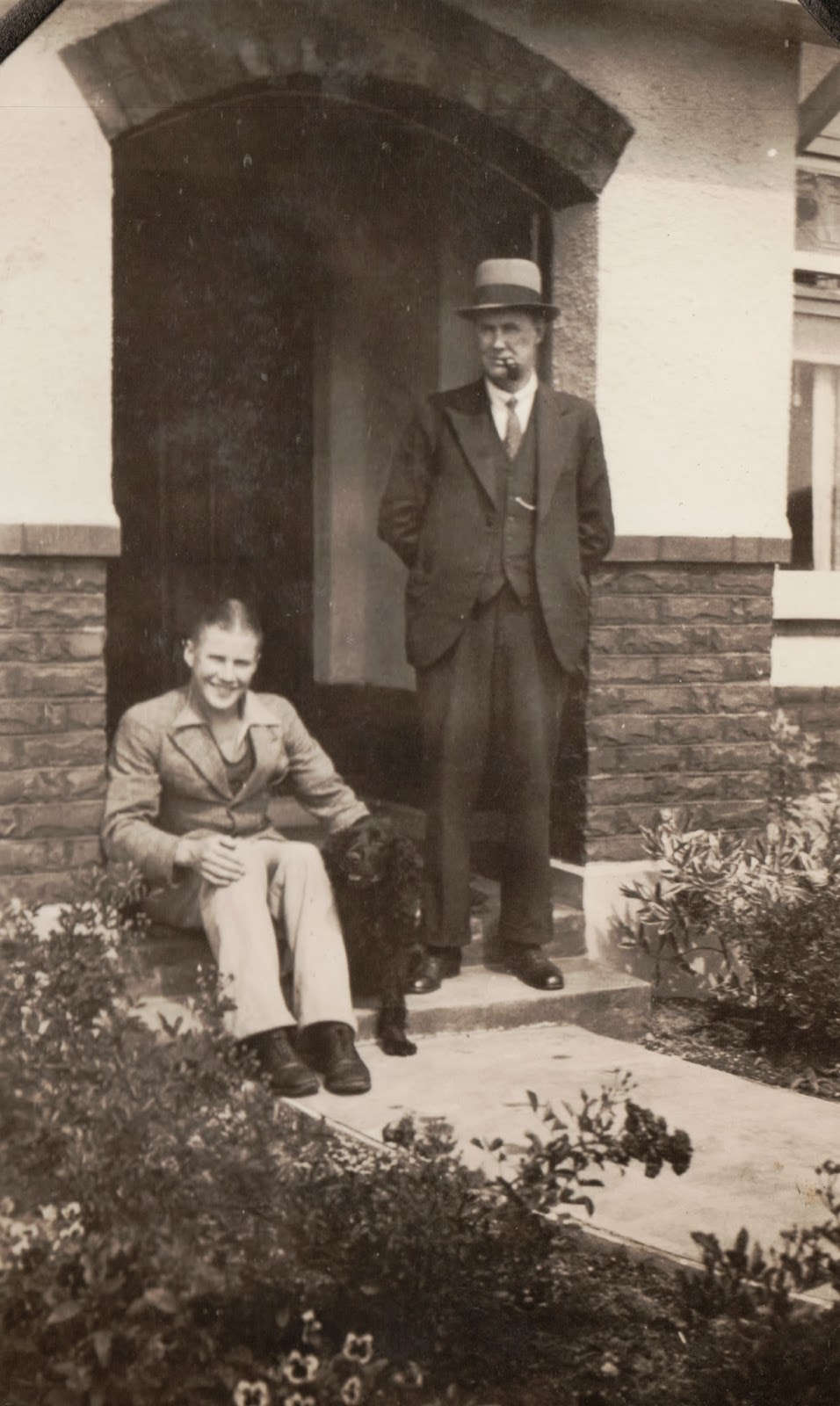
 The second photo was taken just in front of the Aylmer St porch, and shows Jack with his father Daniel and brother Arnold, who must both have come down to Christchurch for some occasion. Daniel and his wife Mary Bridget Morrissey emigrated from Cork in 1875 with their first baby daughter,changed their surname to Morrison,  and had another fourteen children in the district of Canvastown, Marlborough NZ. Daniel began his working life as a messenger boy in Cork, and retired as a much respected company secretary of a local cheese factory. A large brood indeed, but in those days babies just happened, and four of the Morrison children died in infancy. Of the remaining sons, Bill, the eldest, was a farmer, and three of his brothers became lawyers, including the two above, but missing from any future family gatherings would be their brother Austin Lindsay, who was killed in the Battle of the Somme. On Sept 9th 1916 he wrote his last letter home: 'If anything should happen to me try and bear it Mother, as cheerfully as possible, just for my sake.  I can't write any more, there is a great deal I would like to say but don't know how to; I send my fondest love to all and hope to meet you all again.  Farewell now Mother mine, with fondest love from your son Austin.xxxxxxxx. '
Lest We Forget
Next are three photos taken when Mona and daughter Jean visited Mona's sister Ruby and her husband Will in about 1935. Will Berry and his son Jack posed in the doorway of their Invercargill home.


The Invercargill home to which the arched doorway is attached
A couple of charmers: Jack, right, with his older brother Doug, still in the doorway
 Sadly Jack [John Waldwyn Berry], born in 1920, was to be killed in 1943 in Italy. The report from the Auckland War Memorial Museum Cenotaph Database records that "[At] 8:00 am on 21 November 1943, Corporal Berry and two others crossed the Sangro River. Arriving on the further bank, Berry left his men behind and went on alone to the foot of a cliff. He left his gun and then, apparently, climbed the cliff unarmed. He did not return, and nothing more was heard of him until months later when his grave was discovered near Chieti, Italy". So there was to be equal heartbreak for sisters Mona and Ruby,  mothers of cousins Ken and Jack.

On a happier note, here are my paternal grandparents Oliver and Myrtle Cruickshank, standing in the alcove of their home in Rangiora NZ, in 1949, and then no doubt one of them has taken a shot of their son Ian and his fiancee Jean in the same setting.  Jean has captioned the photos accordingly.

Mr and Mrs Cruickshank
'A future Mr and Mrs'

The Cruickshank family home in Park St Rangiora. Granddad Oliver was a keen gardener.

Back in the Aylmer St porch a few months later, we see Mona and Jack again, all dressed and ready for the wedding of their daughter Jean to Ian Cruickshank on 22 April 1950.


Here too are  Aunties Bess and Flo, two more sisters of Mona, also set to go to their niece Jean's wedding.

 Finally, here's a doorway photograph taken in far off Turriff Aberdeenshire, ancestral home of my Cruickshank ancestors. During the year spent in the UK in 1953/4, my parents visited the mothers of all the crew members who had perished with Ken. We also called in on some relatives like my great great Aunty Kitty in Margate, as discussed in  a previous post, and also my great grandfather's cousin, George Morrison Cruickshank, who ran the chemist shop in Turriff, where we stayed in a flat above the shop for a few nights.  Pictured in the doorway with a small yours truly are George, born 1874, and his daughter Janet, born 1919.

 Amazingly just a couple of weeks ago another Cruickshank descendant in Invercargill NZ showed me this 'matching' postcard that George had sent to her family back in the 1920s. On the back George wrote that it showed him standing in his shop doorway, with his little daughter Janet standing on the kerbside.


High St, Turriff, 2003. 


 The Cruickshank pharmacy in Turriff is still run by Alan, one of George's grandsons. We met him there but didn't think to pose in the doorway.

For more doorstop gatherings and reflections, go to Sepia Saturday 203. 


Thursday, 7 November 2013

Oh, I do like to be beside the seaside...


I don't have any photos of photographers or cartoon style cats, but I do have lots of pictures of people and beaches. Here in Australia we take the glorious golden sand at most of our beaches for granted, and are horrified at much of what the English call the seaside - gravelly, pebbly, rocky grey sand that you couldn't walk on without shoes, let alone lie back and sunbathe on a towel, although somehow the locals seem to do just that. Alternatively they lounge about sunning themselves  in deckchairs under a pale sun. At some English beaches I've visited  the children were making mud castles, rather than sand castles like this lovely one snapped at St Kilda beach Melbourne earlier this year!


So what to choose for this week's blog topic? I decided to be rather self-indulgent and to display a few more of the photos from pages of the scrapbook my mother made for me as a momento of our year in England from 24 October 1953 to 1 January 1955, when my father was on a research fellowship at Cambridge.

Jean and Joanna visit Gt Gt Aunty Kitt and her friend Hetty, in August 1954
In the summer of 1954 Dad, Mum and I went down to Margate Kent, to visit my father's Great Aunty Kitt. Kate Annie Byles was Dad's grandfather Thomas Alfred Byles' youngest sister. Thomas was born in 1863 in Mile End London, and according to family legend he left home in his early teens and stowed away aboard a ship called the Rakaia, bound for New Zealand. He was certainly living at home with his parents and siblings at the time of the 1871 census, but by 1881 he was not to be found either with the family or elsewhere in England. The Rakaia made voyages to NZ in 1878 and 1879, but I haven't yet managed to discover any documentation confirming that Thomas was made to work as a cabin boy when discovered on board, or that he was kept on Somes Island in Wellington Harbour until he was of age, but nor does he appear on any passenger list that I can find. Apparently Thomas told my aunt that he ran away because he didn't like his father's new wife, but the evidence does not bear this out. His parents George William Byles and Mary Catherine Daw were first cousins, who were married in 1847 and in fact remained together until George's death in October 1889, which occurred just a couple of weeks before son Thomas was married in Wellington NZ. Brother Alexander, a ship's steward, was a witness to the wedding. Alexander travelled the world and eventually settled in NZ himself. Born in 1871, Kate must only have been around seven or eight at most when her brother Thomas left home, and she never saw him again.  He died in 1951, but must have kept in touch with his English family. Consequently in 1954 my parents were able to meet his youngest sister Kate, the last surviving member of George and Mary Catherine's twelve children. She never married, and passed away in 1958. Hopefully she enjoyed the visit of her great nephew and great great niece. I think she must have been the only 'great' relative I ever actually met!
10 Holly Lane  Margate, home of Kate Byles, 1954

I'm not sure which half of this house belonged to Miss Byles, but as this street view below snipped from Google maps shows, it has changed little in almost 60 years.


Just in case  you're wondering about the relevance of all this to the topic, here it comes: 
After visiting Great Great Aunty Kitt, Mum, Dad and I headed down to the seaside to enjoy the 'leisure and pleasure' offered there.

Enjoying  icecreams at the beach - yum! Note my Dad did not feel any need to remove either his shoes, his jacket or even his tie.
Testing the water
Mum's caption here reads: "Joanna demands a donkey ride!"
 I think the donkey looks happy too.
Donkeys were a beach attraction at Margate for 118 years, and it was the first beach to have them. In 2008 they were retired, due to illness in the donkey owner's family. A Daily Mail news item about their history can be read here.  When I visited Margate again in 2009, the town and its beach were looking rather depressed and neglected, but it seems the donkeys are back again now and hopefully the seaside town of Margate  has also been revived. Unlike most English beaches, it does have the attraction of good sand!

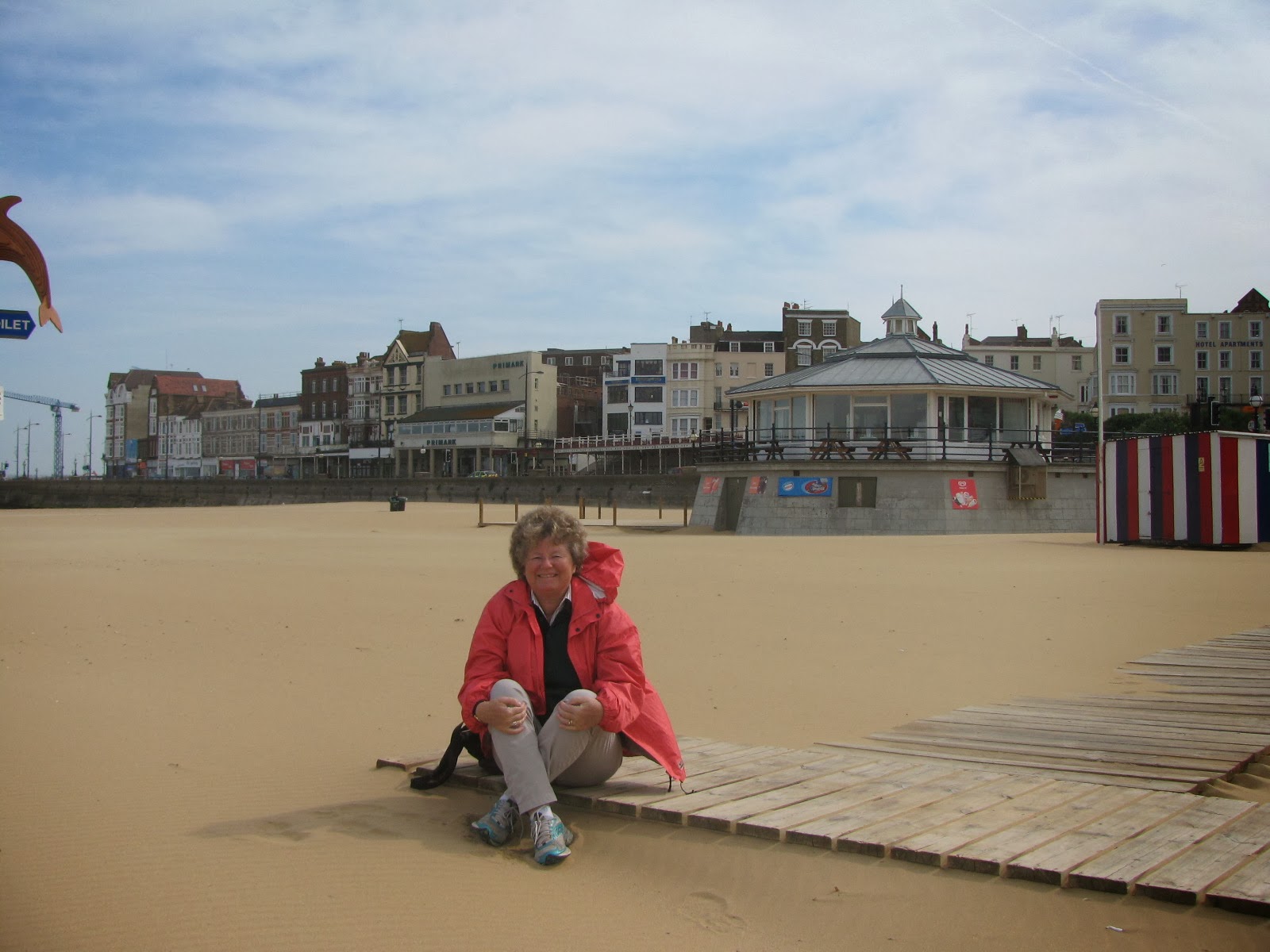
Visiting in May 2009, we practically had Margate beach to ourselves

Which way to ...?

Deckchairs and Sunbeds,  For your Leisure and Pleasure, as the sign says


In the scrapbook Mum also pasted these two postcards together with the snaps, and there's even a piece of seaweed that has been preserved all this time.


I love those chalky white cliffs


To finish, here are some views of one of my favourite Australian beaches, at Hawks Nest on the mid north coast of  NSW,  where we are lucky enough to have a beach unit. There's a 15 km stretch of sandy beach, if you care for a stroll. Margate, eat your heart out!

Winda Woppa, Hawks Nest NSW
View to Cabbage Tree Island from Bennetts Beach Hawks Nest

 Looking along Bennetts Beach to Yaccaba Headland 

Now for more subjective seaside reflections, just kick off your shoes and socks and head on over to Sepia Saturday 

Monday, 4 November 2013

Ancestral homes, then and now


I've been away in NZ for the last week and a half, but I really wanted to contribute a late blog for this topic, as it brought to mind a number of houses that are of significance to my family tree, and the changes that have occurred to them since being occupied by family members.

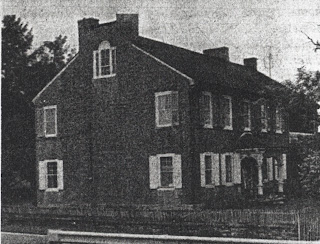
 The first house on my list was built by or for my husband's 3x great grandfather Dan Calwell in White Deer Mills, Union County, Pennsylvania in about 1820. This photograph was kindly sent to me in 2007 by Jane Shuman, a local resident. We had visited the area ourselves earlier that year but unfortunately at the time I was unaware of the location and continued existence of the house. It would have been great to see inside it too, but apparently the owner in 2007 was not particularly receptive to visitors. A letter written by two ladies who were living in the house in 1962 described it as "a beautiful old house with fireplaces in every room, nice mantels and six bedrooms". Clearly it was and still remains a solid and substantial home. Dan Calwell was a prominent businessman who was well thought of for his progressive views on community welfare and free public education. He represented Union County in the house of Representatives in 1820-21, and on his death was eulogized in the Pennsylvania Parliament as being "[A] man of integrity and intelligence; ...No man belonging to this body stood fairer or higher, and no man among his friends and acquaintances, enjoyed more of their respect and regard than Mr Caldwell... He was a kind warmhearted man, an exemplary parent, and a firm undoubted friend of his country and her institution. The loss of such a man creates a chasm in society which cannot be easily filled up."
Dan and his second wife Jane Huff lived in this house, at which the local elections were held, from 1820 until Dan's death in 1836, and had a family of eight children here, two of whom emigrated to Australia in 1853. Dan's great grandson Arthur Calwell  followed in his ancestor's political footsteps, having a distinguished career which culminated in his becoming the leader of the Australian Labor Party from 1960-1967.

Old photograph of Dan's house from a historic publication


The home of Daniel Calwell and family became known as High Mansion after a subsequent owner named Henry High. The land on which it stands was once owned by a lady known as the Widow Catherine Smith, who built the original mills on the site in about 1785 and was legendary for having walked some thirteen times from there to Philadelphia, a distance of 160 miles,  in her efforts to defend her rights to the  property.
The next image comes from photograph of a painting of a farm known as Oakdale, which was established in 1875 near the town of Gore by my 2x great grandfather Adam Cruickshank, who emigrated to Bluff NZ in 1863 with his wife Charlotte and family.  Adam and his sons ran the property successfully for many years, running crops and livestock, but a grandson who inherited it was not such a wise manager. Consequently the property is no longer owned by Cruickshank descendants, so this painting by granddaughter Charlotte Annie Petrie is all that we have to remember it by. Charlotte was an accomplished artist who travelled to London in the 1920s to study at the renowned Slade School of Art. I was able to visit the property recently as part of a celebration of the 150th anniversary of the Cruickshanks' arrival in NZ. It is now a dairy farm, and I can attest to the fact that while the original house and outbuildings have not survived, some of those tall oak trees do still exist.

Oakdale farm, originally owned by Adam and Charlotte Cruickshank

Next is a photograph of the home of another set of 2x great grandparents, Charles and Jane Young, who emigrated from Ballater Aberdeenshire to Lyttleton NZ in 1851 and settled at Kaiapoi, north of Christchurch, where they raised a large family.  The date of the photograph is unknown, as is the identity of the young boy on the lawn, and it may actually have been taken early last century, after Charles and Jane had passed on, but if so, the house would have been in the possession of one of their sons.  It looks friendly and welcoming, and I especially like the fact that the family cat occupies central spot in the photograph! The weddings of several Young daughters, including my great grandmother Jane Isabella, took place here. Again, sadly it appears this family home no longer exists.
Woodside, the Young family home near Kaiapoi, NZ
My grandparents John and Mona Morrison built their home in Aylmer St Somerfield, in Christchurch NZ in the early 1920s. Jack was a lawyer who had to work hard to complete his education at night school after leaving school and joining the public service at fourteen. Four of the six Morrison children were born here in their simple but comfortable dwelling. Jack became Commissioner of Stamp Duties for Christchurch, and was very well thought of by his legal colleagues. The garden he cultivated in his spare time was often admired by passers-by, and Jack kept the lawns well manicured. He provided Mona with flowers to decorate the home, and his vegetables and fruit trees kept the family supplied with good food.

The Morrison family home in Aylmer St in the 1920s

Mona relaxing on the lawn at Aylmer St with her two eldest children Patricia and Ken, c. 1925.

A photo in the garden at Aylmer St, taken when my mother took us on holiday from Australia for a rare visit to Nan, Granddad and their youngest son Peter, over Christmas in 1960.

The home appararently survived the Christchurch earthquakes reasonably intact, and has recently been recently sold, having been much modernised by with various additions by later owners, such as as a deck for example, as shown in this photo that accompanied the sale advertisement:

 The property is now fenced and the house largely hidden from public view, but a glimpse from the street shows that the chimney pot  is still missing, a common result of earthquake damage.  No doubt the toilet across the covered way from the back door has been either removed or  updated, and an inside bathroom installed. Nothing that Jack and Mona ever desperately felt a need for. My mother recalls that Saturday night was bath night for all the children in the tub in the kitchen, with plenty of hot water provided by the 'wet-back' behind the kitchen fire, and that her father called it 'pig-killing night'!

My parents lived for over twenty years in Canberra in the house pictured below, in the suburb of O'Connor. I remember it as being a great family home which we moved into in 1965, the year I started high school. Over the years a bedroom and rumpus room was added on at the back, in a style sympathetic to the original architecture. Here's a photo of my mother standing in the front garden, which was my father's pride and joy. Dad followed in the tradition of his father and father-in-law as a keen gardener, and nurtured a productive vegetable garden and many fruit trees around the back, as well as many flowers and shrubs. Great views over Canberra and nearby Black Mountain from the large living room window! There's a photo of that view somewhere, but I'm not sure in what album it's presently hiding.

My parents' home in Wattle St O'Connor ACT, c. 1987, after which they retired to live on the NSW Central Coast


Happy memories of parties and family celebrations, both inside and in the garden, such as my 21st birthday, a casual affair with friends around for a BBQ and cake.  I also had a party here in the garage/basement for my eighteenth birthday, and at the same time we celebrated the end of our final year school exams. Seems so long ago now!
Several owners later in 2013, our former home looks very different in external appearance - I know which I prefer!

The only house we have ever had built was also in Canberra, in 1977 in Kaleen, which was then a new suburb not far from O'Connor. We couldn't afford architectual design, but were inspired by a love of shade-creating verandahs popular in Australian county towns to adapt a standard builder's plan in line with that concept.

Foggy inspiration for the future, near Forbes NSW

Our' 'creation' in progress, with  a verandah on 3 sides, was the first house to be built on the block


Street view of the finished product in 1979, with fledgling garden.

 In the event we only lived in our 'dream house'  for just over two years, before moving to Sydney for work in early 1980, when our first child was just two months old. Last time we drove by a couple of years ago it didn't look too much different, apart from looking a bit neglected, and the brick carport built by my husband and his father was still standing firm too. I'm fairly certain that if subsequent owners have done anything inside, they will definitely have replaced the 1970s style orange kitchen benches and also the cork tiles that we painstakingly installed!  My mother presented us with an orange canary named Fernando to match the decor, and he survived almost 20 years, two cats and numerous moves. 


And now a few houses later, we live in Melbourne, in a house we love that is around 103 years old and has lots of character. No more new houses for me! The sepia photograph of its front porch decorates the top of this blog, and for anyone interested  I've previously written a little on its history here at at http://turnerstreettopics.blogspot.com.au/2013/08/turner-street-then-and-now.html