Showing posts with label Hawks Nest. Show all posts

Tuesday, 14 June 2016

PLEASE Don't call me a Koala Bear!


This week's prompt photograph shows a koala with its mouth wide open, supposedly yawning. Koalas are marsupials that are native only to Australia, although of course some have been exported to zoos around the world.  They live in eucalyptus trees and only eat certain type of eucalyptus leaves. According to the Australian Koala Foundation, there are less than 80,000 koalas left in the wild, and that figure could well be a lot lower, because numbers Australia-wide are hard to estimate. The site provides a lot of interesting information about koalas and their habits.

Below is a photograph from one of my mother Jean's albums, showing her friend Elaine, cuddling a koala somewhere during a visit to Australia in 1969. Elaine and Jean became life-long friends, from the time they met when Elaine was a student at a deaf school and Jean was a young newly-qualified speech therapist, teaching there in her first job. Jean moved to Australia but Elaine still lives in New Zealand, where there are no native fauna at all, only birds and flora.  The photograph must have been taken in a zoo or wildlife park, because you can't pick these animals up in the wild. They may look cute and cuddly but they are not tame and have to be taught to become used to human contact.


The next photo shows our older daughter and son with a koala at the Lone Pine Koala Sanctuary in Brisbane Queensland in about 1984.


A few years later in 1987 our two boys were at the same location, with number one son now showing his little brother how to do it.  I can imagine that some koalas might get rather tired of posing with humans all day long and that instead of yawning, the koala in the Sepia Saturday  prompt could be in fact be yelling: 'I've had enough cuddling, please just go away and leave me in peace!"


The following four photographs are ones I've taken of koalas spotted in their natural habitat, on several  Xmas vacations in the small town of Hawks Nest on the mid-north coast of New South Wales, where we are lucky enough to have a holiday unit. The koala colony there is very small, with no more than 12-15 koalas, but they can occasionally be found in the large gum trees lining the local streets, high enough to be safe from dingoes, local dogs and other animals


This next photograph was published on Facebook just recently, and shows a baby koala that had fallen out of a tree during a storm in Hawks Nest, with a gentleman trying to hold it up and coax the mother to come down and get it. Unfortunately that didn't happen, so the baby is now being looked after by a member of the local koala care group at Hawks Nest.


Hopefully you can see more cute pictures and and read all about it here  on the Daily Telegraph's facebook page.

There is one area in Victoria where koalas can be seen in large numbers. This is in the Cape Otway National Park, but sadly overpopulation by koalas has resulted in great damage to the trees on which they rely, with the consequence that many of the koalas have been starving. Despite public outcry their numbers have had to be substantially culled by euthanasia, because they don't adapt well to being re-located. I took these photographs below in Cape Otway in October 2012, and you can see that some of the trees are quite lacking in leaves. There were just too many koalas for them to be able to survive happily and in good condition. You can read more about the current management of koalas in Cape Otway here.


                                          A number of koalas are competing for food in this tree.


Male koalas are territorial and will fight other males for their territory and their right to mate with females. That koala in our prompt could well be attempting to assert his domination and scare others away. I can certainly attest to the fact that they make a lot of noise grunting, screaming, growling and bellowing, particularly at night, which you notice if you are staying anywhere near a koala habitat!


One more koala from my photo collection, this time a solitary fellow who was enjoying the sunshine in the Grampians National Park. 


I'll just finish with a plea for people to not use the word 'bear' when talking about koalas, because they simply are not related to bears at all. I suggest that this is another possibility for the koala in our prompt. He could be yelling that he is not a bear, or perhaps could be singing the song "Please Don't call me a Koala Bear", sung by Don Spencer, which you can listen to here:


For more posts on koalas and other cuddly furry creatures, or perhaps  on yawning or singing or just open mouths, go to Sepia Saturday #335

Thursday, 7 November 2013

Oh, I do like to be beside the seaside...


I don't have any photos of photographers or cartoon style cats, but I do have lots of pictures of people and beaches. Here in Australia we take the glorious golden sand at most of our beaches for granted, and are horrified at much of what the English call the seaside - gravelly, pebbly, rocky grey sand that you couldn't walk on without shoes, let alone lie back and sunbathe on a towel, although somehow the locals seem to do just that. Alternatively they lounge about sunning themselves  in deckchairs under a pale sun. At some English beaches I've visited  the children were making mud castles, rather than sand castles like this lovely one snapped at St Kilda beach Melbourne earlier this year!


So what to choose for this week's blog topic? I decided to be rather self-indulgent and to display a few more of the photos from pages of the scrapbook my mother made for me as a momento of our year in England from 24 October 1953 to 1 January 1955, when my father was on a research fellowship at Cambridge.

Jean and Joanna visit Gt Gt Aunty Kitt and her friend Hetty, in August 1954
In the summer of 1954 Dad, Mum and I went down to Margate Kent, to visit my father's Great Aunty Kitt. Kate Annie Byles was Dad's grandfather Thomas Alfred Byles' youngest sister. Thomas was born in 1863 in Mile End London, and according to family legend he left home in his early teens and stowed away aboard a ship called the Rakaia, bound for New Zealand. He was certainly living at home with his parents and siblings at the time of the 1871 census, but by 1881 he was not to be found either with the family or elsewhere in England. The Rakaia made voyages to NZ in 1878 and 1879, but I haven't yet managed to discover any documentation confirming that Thomas was made to work as a cabin boy when discovered on board, or that he was kept on Somes Island in Wellington Harbour until he was of age, but nor does he appear on any passenger list that I can find. Apparently Thomas told my aunt that he ran away because he didn't like his father's new wife, but the evidence does not bear this out. His parents George William Byles and Mary Catherine Daw were first cousins, who were married in 1847 and in fact remained together until George's death in October 1889, which occurred just a couple of weeks before son Thomas was married in Wellington NZ. Brother Alexander, a ship's steward, was a witness to the wedding. Alexander travelled the world and eventually settled in NZ himself. Born in 1871, Kate must only have been around seven or eight at most when her brother Thomas left home, and she never saw him again.  He died in 1951, but must have kept in touch with his English family. Consequently in 1954 my parents were able to meet his youngest sister Kate, the last surviving member of George and Mary Catherine's twelve children. She never married, and passed away in 1958. Hopefully she enjoyed the visit of her great nephew and great great niece. I think she must have been the only 'great' relative I ever actually met!
10 Holly Lane  Margate, home of Kate Byles, 1954

I'm not sure which half of this house belonged to Miss Byles, but as this street view below snipped from Google maps shows, it has changed little in almost 60 years.


Just in case  you're wondering about the relevance of all this to the topic, here it comes: 
After visiting Great Great Aunty Kitt, Mum, Dad and I headed down to the seaside to enjoy the 'leisure and pleasure' offered there.

Enjoying  icecreams at the beach - yum! Note my Dad did not feel any need to remove either his shoes, his jacket or even his tie.
Testing the water
Mum's caption here reads: "Joanna demands a donkey ride!"
 I think the donkey looks happy too.
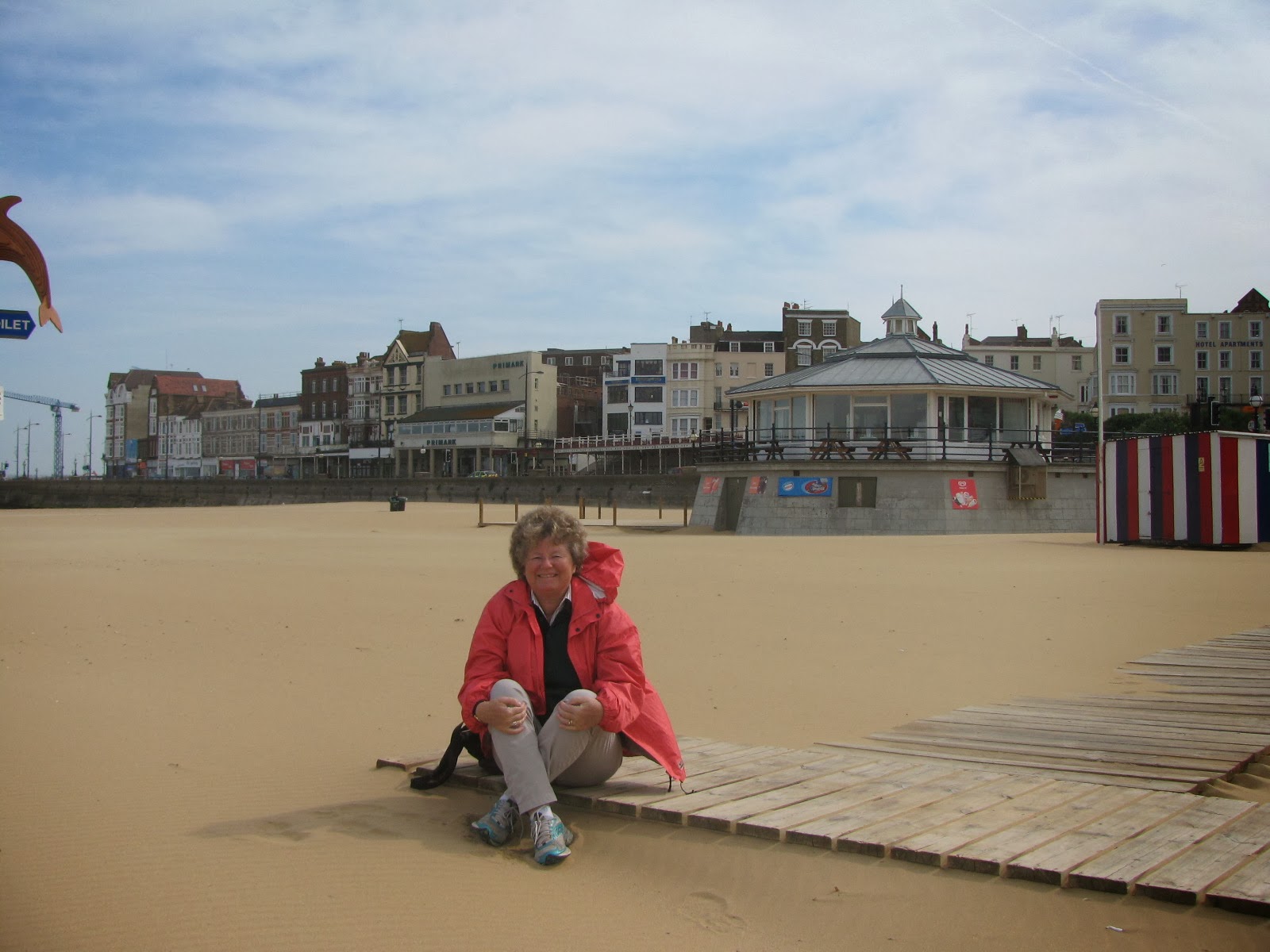
Donkeys were a beach attraction at Margate for 118 years, and it was the first beach to have them. In 2008 they were retired, due to illness in the donkey owner's family. A Daily Mail news item about their history can be read here.  When I visited Margate again in 2009, the town and its beach were looking rather depressed and neglected, but it seems the donkeys are back again now and hopefully the seaside town of Margate  has also been revived. Unlike most English beaches, it does have the attraction of good sand!

Visiting in May 2009, we practically had Margate beach to ourselves

Which way to ...?

Deckchairs and Sunbeds,  For your Leisure and Pleasure, as the sign says


In the scrapbook Mum also pasted these two postcards together with the snaps, and there's even a piece of seaweed that has been preserved all this time.


I love those chalky white cliffs


To finish, here are some views of one of my favourite Australian beaches, at Hawks Nest on the mid north coast of  NSW,  where we are lucky enough to have a beach unit. There's a 15 km stretch of sandy beach, if you care for a stroll. Margate, eat your heart out!

Winda Woppa, Hawks Nest NSW
View to Cabbage Tree Island from Bennetts Beach Hawks Nest

 Looking along Bennetts Beach to Yaccaba Headland 

Now for more subjective seaside reflections, just kick off your shoes and socks and head on over to Sepia Saturday