The prompt above shows a smiling young woman standing outside a house with a wrought iron fence.
My first photo in response shows another unknown young lady, smiling as she stands outside premises of the Quebec Liquor Commission. It comes from the album I have of photographs taken by my Uncle Ken when he was doing his pilot training in Canada in 1942. I have no idea who this attractive girl was but it seems likely that Ken met her while he was over there. She may or may not have been the same girl who is with Ken in the next photo. I can't be sure, but the girl with Ken is wearing glasses, unlike the girl in the first picture. I hope she found someone else with whom to enjoy life after Ken left for England, sadly never to return, but at least they look happy together at this moment in time.
According to Wikipedia, the Quebec Liquor Commission was formed in 1921 to control the sale of liquor in the province of Quebec. Why Ken chose to pose his friend outside such a store is not known, but here is a photograph in Wikipedia showing customers queueing for their liquor supplies outside another QLC store, taken only a couple of years later. Perhaps Ken had just made a purchase there himself.
Another feature of our prompt is the wought iron gate or fence, which reminded me of this next photo, showing the first home that my parents lived in after their marriage in 1950. My mother wrote in her Life Album that they were "fortunate to be able to rent this beautiful old home in Barrington St Christchurch. The grounds were extensive and Ian (my father) enjoyed looking after them. The rooms were large and in the dining room and lounge were huge dressers." Unfortunately they had to move out shortly before I was born.
A few years later while we were living in the UK and Dad was working at the Low Temperature Research Station in Cambridge, he was invited to attend a Scientific Congress in Paris. My parents were able to leave me with friends and go over to Belgium and France for about a week, where Mum has captured Dad, looking suitably debonair beside an archway at the Paris Hotel de Ville, adorned with a wrought iron gate.
For more fleeting moments in time, possibly prompted or inspired by that unknown girl standing outside the unknown house with a wrought iron fence, there's no need to stand waiting at the gate, just walk on in to Sepia Saturday 390#
Sepia Saturday prompt #387 shows the cockpit of a 1948 B-36 bomber. I think I have a pretty good match in my family history collection this week.
The photographs below were taken by my uncle Kenneth Forbes Morrison of other planes that were flying alongside his, when he was training to be a pilot in Canada in WW2. They are Cessna Cranes, as shown here on the Canadian War Plane Heritage Museum site. The Cranes were used by the RACF in Canada to teach recruits from allied Commonwealth countries to fly multi- engined aircraft. Ken from New Zealand was one of those recruits, as was my father-in-law Bob Featherston from Australia. Ken took quite a few snaps of his time in Canada and the US and I think that after his death either my mother or another member of the family must have lovingly placed them in an album of which I am now the keeper. I've blogged previously about Ken, the uncle I never knew.
This photograph of the Cessna controls is also from Ken's album. The clue to the type of plane it was is the word Cessna, which appears on each of the foot pedals below the control panel.
I don't think this is Ken but it may be a snap he took of one of his fellow pilots, standing in front of a Cessna Crane and proudly displaying his graduation certificate.
After Ken qualified he went to England where he flew a Halifax heavy bomber. It was in one of these much larger planes that he was tragically shot down and killed while taking part in a bombing raid over Germany, along with all his crew and so many other young men, on 23 June 1943.
Last week we were in London and took the opportunity to visit the RAF Museum at Hendon, which has a lot of old aircraft on display. I don't believe they had a Cessna Crane in their collection, but they did have this unrestored Halifax, which had been salvaged many years later from the depths of a Norwegian lake. It is one of only three surviving examples of the Halifax. Here are a couple of photos I took of it.
View inside the cockpit of the recovered Halifax, which a friendly volunteer guide pointed out was very spacious, compared for example with the Lancaster bomber flown by Bob Featherston.
The insignia of the 78th RAF Squadron to which Ken was seconded
This restored Lancaster heavy bomber was also part of the collection
For more blogs prompted by Sepia Saturday #287, just check those dials, pull the levers, raise the flaps, prepare for take off and go up, up and away to your next destination here
"They had bombed London, whether on purpose or not, and the British people and London especially should know that we could hit back. It would be good for the morale of us all."
— Winston Churchill, British Prime Minister, ordering the RAF to start bombing German cities, cited in M. Hastings, Winston's War, 25 August 1940 It may have been good for British morale generally but it was far from good for all the families of those thousands of young men who were to lose their lives as a result of Churchill's order, not to mention all the civilians on the ground who must also have been killed. Here is a song for Ken, Blue Yonder, sung by my favouite Canadian, David Francey. https://youtu.be/gOCzkekEKpQ
Cute kids indeed! Those two terrors like they would be getting into mischief just as soon as they climbed off that make-believe axe-headed horse of theirs.
I've posted about kids on rocking horses before here, and I'm presently on holidays but before I left home I found this sweet little studio portrait of my mother's sister Joan Patricia and her brother Ken. The photograph was probably taken in about 1925 or 1926, the year my mother was born. I've blogged about both Pat and Ken before. I never knew Ken, because he was killed in 1943 in WW2 at only 19, well before I was born, but my Aunty Pat almost made it to 90 and achieved much in her long life. Here they are just innocent little children looking angelic and natural together, even though this is a posed shot. I love it.
For more posts on the theme for Sepia Saturday #384, click here.
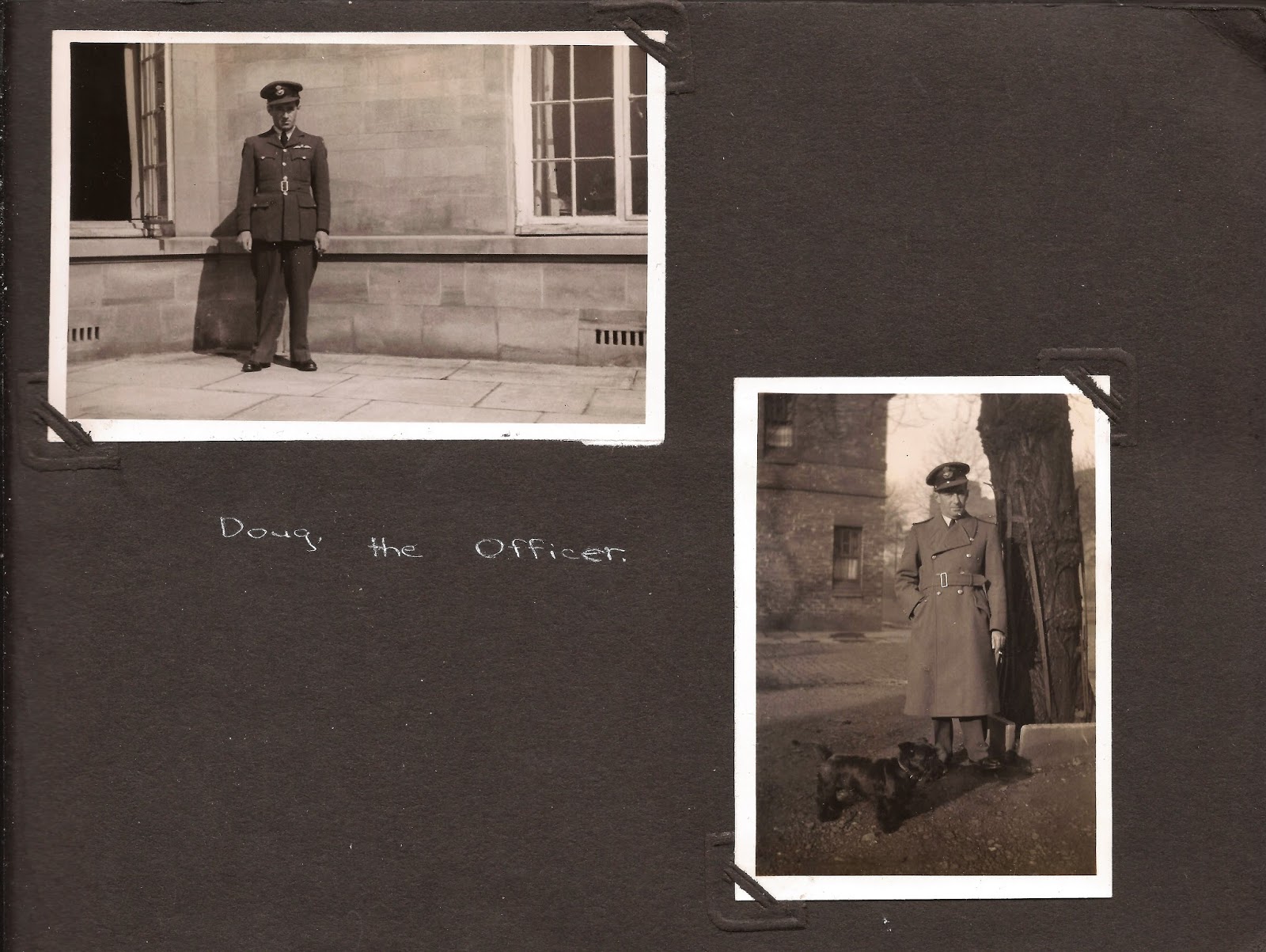
I have previously blogged about various relatives who served in either the first or the second World War, but I don't think I've mentioned this gentleman, Douglas Drummond Lind, who was a second cousin to my mother Jean Cruickshank nee Morrison. Doug's grandmother Emily Young was an older sister of my mother's grandmother Jane Isabella Young. Emily was born in Aberdeenshire in 1847 and emigrated to New Zealand in 1851 with her parents Charles Young and Jane Patterson, her older sister Anne and baby brother William. Charles and Jane had another seven children born in NZ. When Emily Young got married in 1865 to John Andrews, her little sister Jane Isabella, aka Jeanie, was only 5. Emily and John Andrews had twelve children.
Doug Lind was born in 1910. He was the eldest son of Emily's daughter Emily Mary Andrews, born 1880, who married William Andrew Lind in 1909. Jane Isabella Young married Charles Forbes in 1897, and their daughter Mona, born 1897, married John Morrison, aka Jack, in 1919. My mother Jean was born in 1926, so again there was quite an age gap between her and her second cousin Doug, but clearly the family ties remained close, despite the age differences and the fact that Charles and Jane Young had 55 surviving grandchildren, all first cousins to Jean's mother Mona,
The first photograph above is definitely a studio portrait of Doug Lind in uniform.
I believe the lower portrait is also of him at a later date, although I'm not certain of that fact as there is no identification on the reverse.
The following page of snaps from my mother's album shows Doug and a fellow airman visiting the Morrison family at their Christchurch home. In the third photograph are my mother's parents Jack and Mona Morrison nee Forbes, first cousin of Doug's mother Emily Mary, the Morrisons' elder daughter Pat and two of their sons, Derek and Peter, who I'm sure is playfully wearing cousin Doug's cap.
In April 1942 on another page of the album below we see Ken with his father Jack, older sister Pat, little brother Peter, and his friend Geoff. Again Peter is wearing 'his' pilot's cap.
I'm not sure of the date of the first page above, but you can see from the caption that those on the following pages were sent from England in 1944. Sadly by that time Ken Morrison had been killed in action, when his plane was hit while flying on a mission over Germany on 25 June 1943.
Doug was promoted to the rank of 2nd Lieutenant in 1944. Unlike my Uncle Ken, he was one of the lucky ones who survived the war and returned home, where hopefully he was able to resume life in peaceful New Zealand. Earlier this year I discovered a friendly and amusing letter that he had written to his cousin Jean on the eve of her wedding in 1950. I would like to have included an extract here, but unfortunately I seem to have since mislaid it. My filing system clearly leaves a lot to desired! Doug married the following year and had a family himself. He passed away in 1986. I'm not in contact with any of his children or grandchildren, but if any of them should come across this blog about Doug, I would love to them get in touch. In particular, perhaps they can confirm whether or not the second portrait is of Doug.
Out of interest, since publishing my blog about Ken and his airforce friends which can be read here, I've had contact from relatives of two of the other men who were also in the nightclub photograph, telling me how they greatly enjoyed seeing the photographs and reading the blog.
For more blogs on the theme for November of War and Peace for Sepia Saturday #345, click here.
It's D-Day this week and the Normandy Landings on 6 June 1944 are currently being commemorated.
I would like to dedicate this post to my mother's brother Kenneth Forbes Morrison, 20.07.1923 - 25.06.1943, and his mates in the NZ Air Force. Ken did not get to experience or hear about D-Day. He was a pilot of a Halifax bomber who died together with all his crew when their plane was shot down over Wuppertal, while they were taking part in a raid on the night of 24/25 June 1943. He had just been promoted to the rank of flight sergeant. Ken was initially interred in the Military Cemetery in South Cologne, but his remains were subsequently re-buried in the Rheinberg War Cemetery in the Rheinland. I've posted childhood photographs of Ken in previous blogs, for example here, here and here, and you can see a photograph of Ken and his ill-fated crew here.
When his mother Mona reluctantly agreed to allow him to enlist because he was under age, Ken left his parents' home in Christchurch New Zealand and in early 1942 he embarked for Canada to continue his training under the Empire Air Training Scheme. The training took place in Brandon, Manitoba, Canada, and no doubt Ken saw the whole trip as a great adventure. He must have taken a camera with him to record his travels, because we have an album of snaps from his time in the air force, 1942-1943. Quite a few photographs look to have been taken while doing his flying training or are of groups of men at the base, and there is a good one of a plane's instrument panel, but it wasn't all serious training, and there are also quite a few photos of Canadian mountain scenery, or of Ken sightseeing or relaxing with friends. I've selected the following two shots because they show that he must have been able to get leave to visit New York City. He went up the Empire State Building, went out to a cabaret and spent time relaxing on a beach somewhere with a couple of girls, probably locals impressed by these young men in uniform. The beach photo of Ken and friends isn't labelled, but the dinner photograph has identifying information on the reverse, as shown below. It's signed by everyone at the table and gives the venue as Billy Rose's Diamond Horseshoe, W. 46 ST. New York City, on 3 September 1942.
According to the web site of the Hotel Paramount, "from 1938 to 1951, Billy Rose’s Diamond Horseshoe operated in the basement of the Paramount. Known for its vaudeville-style revues, the club featured the day's top entertainers and even inspired a 1940s movie musical of the same name", which starred Betty Grable. The night club re-opened last year and is now a 'prime midtown nightlife destination'. In 1942 it must have been quite an eye-opener for a young man from the sedate city of Christchurch New Zealand.
Ken and friends on the beach
A carefree night out with friends in the Big Apple, at Billy Rose's Diamond Horseshoe, Hotel Paramount.
Ken is fourth from left.
Some of the signatures are a bit hard to decipher, but I think their names could be Sylvia Mettler, Max L Bartley, Caroline Jarrett, Raymond A Lindsay, Johnny R Mayo and Bibi Arundel.
If any of the signatories are still with us, they would have to be in their 90s. Three of the four young men are clearly wearing the insignia of the New Zealand Air Force, and they were all Flight Sergeants with the NZ Air Force.. According to the Commonwealth War Graves Commission web site, the name of Ken's good mate John Russell Mayo appears on the Air Forces Memorial at Runnymede in Surrey, England, which "commemorates by name over 20,000 airmen who were lost in the Second World War during operations from bases in the United Kingdom and North and Western Europe, and who have no known graves. They served in Bomber, Fighter, Coastal, Transport, Flying Training and Maintenance Commands, and came from all parts of the Commonwealth. Some were from countries in continental Europe which had been overrun but whose airmen continued to fight in the ranks of the Royal Air Force."
I think Johnny is on the left in the night club photograph, and Max is sitting opposite Ken, at the back of the table on the right. Flight Sergeant Maxwell Logan Bartley was killed wen taking part in air operations on 4 January 1944 and is buried in the Poix-de-Picardie churchyard in the Somme. He is clearly recognisable from a photograph to be found here on the Auckland Cenotaph Museum web site. The fourth airman Raymond Anthony Lindsay was the only one of this group, and indeed of all the men mentioned in this post, who survived the war to return home to New Zealand, where he died in 1991 aged 70. I haven't tried to trace the men's female dinner companions, who I expect were American girls they had met in New York.
Here are another few photos from Ken's album. The first shows Ken and Johnny horseriding at a farm while on leave in Canada
Johnny Mayo
A bunch of likely lads
Ken and some of his NZ Air Force mates adopt a casual pose for this snap taken in Halifax Canada by Johnny Mayo. Ken is on the right, and the others are Hugh (Beau) Beavis, Mort Langdale-Hunt and Ronald (Snowy) Brown. On the reverse side, my mother has written the dates when they were all killed. Hugh Walter Beavis, son of Arthur and Ethel Beavis of Wellington NZ, died on 25 July 1943 and is buried in Hamburg Cemetery. Maurice Richard Langdale Hunt, son of Albert and Emma Langdale-Hunt of West Melton, Canterbury NZ, died on 30 March 1943 and is buried in Marham Cemetery in Norfolk. I'm not sure of Snowy's precise details, but according to the note, he died in March 1944.
Below are a couple of individual portrait shots of dashing young airman Ken. Richard, one of Ken's younger cousins, recalls a clear memory from age 6, of visiting Ken at home on his last leave before he went overseas. He remembers Ken looking immaculate in his air force uniform, and that he took Richard, his two sisters and Ken's little brother Peter to the dairy to buy them all icecreams. These photographs were taken in 1942 by professional photographers Debenham and Gould, of Glen View Studio, Bournemouth, England, where Ken was initially stationed upon arrival in England. He then completed further courses of training in Shropshire, Suffolk and Berkshire, before converting from Wellington bomber aircraft to Halifax heavy bombers with a unit based in Riccall, Yorkshire. He took part in his first raid over Wuppertal from there, but was then posted to No. 78 Squadron at Holme Moor, Yorkshire, and was on his first operational flight with that squadron when the aircraft failed to return to its base.
In 1969/70 I was lucky enough to be awarded a scholarship which enabled me to go to Germany and spend 3 months living with a host family and attending school there. I lived in the town of Solingen, and visited nearby Wuppertal, not knowing at the time that this was where my uncle Ken had been shot down or that he was buried not very far away. If my mother or grandparents knew, they did not share the information with me, and in any event I don't think I could have asked my hosts to take me to Rheinburg, but I would love to visit there one day.
Grave of K F Morrison at Rheinberg War Cemetery.
Ken with his five siblings before he left for Canada. Only his younger sister Jean, 2nd from left, is still with us, just.
A sad end which left his family heartbroken, but it's good to know from his photo album that at least Ken managed to have some fun in his short life. He was only 19.
Other circumstances, other methods and another war, but the message remains the same. Lest we forget.
To see more Sepian contributions to this week's Open Theme, just head this way
I didn't really think I had many photos of people framed in doorways or porches, but on closer examination my mother's albums come to my rescue again. I could single out just one, but I'm not good at choosing, so will include a few of them here.
Here are my grandparents Mona and Jack Morrison on the porch of their weatherboard home at 2 Aylmer St Somerfield, with their two oldest children Patricia and Kenneth, in about 1925. My mother Jean was the next child to arrive, being born the following year.
Kenneth Forbes Morrison, the baby in the photograph above, enlisted and became a pilot in the Royal New Zealand Air Force. Aged only 19, he was a Flight Sergeant in the 78th Squadron RAF, but tragically Ken and all his crew were killed when the Halifax he was flying was shot down over Wuppertal Germany on 25 June 1943. Sister Jean was sixteen, and has told me she remembers the day they received news of his death as if it were yesterday. The crew members' names appear in one of a large number of books of remembrance maintained for all those RAF members who have died in conflicts worldwide. These books line the walls of the RAF Church of St Clement Danes, London, and are well worth a visit.
The second photo was taken just in front of the Aylmer St porch, and shows Jack with his father Daniel and brother Arnold, who must both have come down to Christchurch for some occasion. Daniel and his wife Mary Bridget Morrissey emigrated from Cork in 1875 with their first baby daughter,changed their surname to Morrison, and had another fourteen children in the district of Canvastown, Marlborough NZ. Daniel began his working life as a messenger boy in Cork, and retired as a much respected company secretary of a local cheese factory. A large brood indeed, but in those days babies just happened, and four of the Morrison children died in infancy. Of the remaining sons, Bill, the eldest, was a farmer, and three of his brothers became lawyers, including the two above, but missing from any future family gatherings would be their brother Austin Lindsay, who was killed in the Battle of the Somme. On Sept 9th 1916 he wrote his last letter home: 'If anything should happen to me try and bear it Mother, as cheerfully as possible, just for my sake. I can't write any more, there is a great deal I would like to say but don't know how to; I send my fondest love to all and hope to meet you all again. Farewell now Mother mine, with fondest love from your son Austin.xxxxxxxx. '
Lest We Forget
Next are three photos taken when Mona and daughter Jean visited Mona's sister Ruby and her husband Will in about 1935. Will Berry and his son Jack posed in the doorway of their Invercargill home.
The Invercargill home to which the arched doorway is attached
A couple of charmers: Jack, right, with his older brother Doug, still in the doorway
Sadly Jack [John Waldwyn Berry], born in 1920, was to be killed in 1943 in Italy. The report from the Auckland War Memorial Museum Cenotaph Database records that "[At] 8:00 am on 21 November 1943, Corporal Berry and two others crossed the Sangro River. Arriving on the further bank, Berry left his men behind and went on alone to the foot of a cliff. He left his gun and then, apparently, climbed the cliff unarmed. He did not return, and nothing more was heard of him until months later when his grave was discovered near Chieti, Italy". So there was to be equal heartbreak for sisters Mona and Ruby, mothers of cousins Ken and Jack.
On a happier note, here are my paternal grandparents Oliver and Myrtle Cruickshank, standing in the alcove of their home in Rangiora NZ, in 1949, and then no doubt one of them has taken a shot of their son Ian and his fiancee Jean in the same setting. Jean has captioned the photos accordingly.
Mr and Mrs Cruickshank
'A future Mr and Mrs'
The Cruickshank family home in Park St Rangiora. Granddad Oliver was a keen gardener.
Back in the Aylmer St porch a few months later, we see Mona and Jack again, all dressed and ready for the wedding of their daughter Jean to Ian Cruickshank on 22 April 1950.
Here too are Aunties Bess and Flo, two more sisters of Mona, also set to go to their niece Jean's wedding.
Finally, here's a doorway photograph taken in far off Turriff Aberdeenshire, ancestral home of my Cruickshank ancestors. During the year spent in the UK in 1953/4, my parents visited the mothers of all the crew members who had perished with Ken. We also called in on some relatives like my great great Aunty Kitty in Margate, as discussed in a previous post, and also my great grandfather's cousin, George Morrison Cruickshank, who ran the chemist shop in Turriff, where we stayed in a flat above the shop for a few nights. Pictured in the doorway with a small yours truly are George, born 1874, and his daughter Janet, born 1919.
Amazingly just a couple of weeks ago another Cruickshank descendant in Invercargill NZ showed me this 'matching' postcard that George had sent to her family back in the 1920s. On the back George wrote that it showed him standing in his shop doorway, with his little daughter Janet standing on the kerbside.
High St, Turriff, 2003.
The Cruickshank pharmacy in Turriff is still run by Alan, one of George's grandsons. We met him there but didn't think to pose in the doorway.