It seems to be agreed that this Irish mother and son were filling the sack with sand, although we don't know what for, or how they would have managed to carriy it away, unless perhaps they were able to drag it to a waiting cart nearby. If it had been kelp they were gathering, that would have been much easier to carry home and use on the garden as fertiliser and mulch, but they may not have had a garden.
My Morrison family in New Zealand enjoyed going to the beach for a day out, specifically to Leithfield Beach, on the east coast, a little to the north of Christchurch. These days on modern highways Leithfield is only about a 45 minute drive from where they lived in Aylmer St Sydenham, but back in the 1920s the cars and roads were not so flash and no doubt the trip took considerably longer. There were closer city beaches such as Brighton and Sumner, but Mona and Jack Morrison seem to have favoured Leithfield, possibly because both Mona's maternal grandparents and her paternal grandmother lived up that way, in Kaiapoi, so she may have known the beach as a child. Her father's half sister Mary Shaw lived at Leithfield with her husband David and their large brood. The Shaw children would have been Mona's half cousins on one side, and her second cousins on the other, but I won't go into that here!
Here 's Jack posing proudly in front of the new car he purchased in 1926, with his son Ken on the running board, ready to drive to the beach for what may well have been the car's first outing.
After winding through the countryside and down the hill to the beach, Ken and his big sister Pat were no doubt keen to kick their shoes off and play in the grey sand with their bucket and spades.
Either before or after the children played on the beach, they enjoyed the attractions of the nearby playground. Here they are with Jack, perching on a seesaw, and it looks like there's a double or maybe triple slippery dip in the background.
Mona and the children on a family-sized swing, which I am told is still there today
Someone else must have been present to take this family shot on the seesaw again. Both Mona and Jack remain quite formally attired, in a dress and a three piece suit with tie. No casual beachwear for them!
I'm not sure what Pat and Ken are up to here, but whatever it is, they look very interested! From the sign in the background, it seems Mona and Jack would have been able to enjoy a nice hot cup of tea with the picnic lunch they had no doubt brought from home for their day out, the first of many over the years in their family car that would eventually accommodate all six children. Mona might have made bacon and egg pie, a great picnic staple and a tradition that has carried on down the generations. I know it was one of Jack's favourite dishes, but in his opinion it had to be accompanied by tomato sauce!
Moving on to February 1956, and here are my parents Jean and Ian Cruickshank with yours truly, relaxing after a swim at nearby Waikuku Beach. This was probably the last time my parents would go there, as we left NZ for Australia just a couple of months later, in April that year. My baby brother would have been about 5 months old, but as there's no sign of him, so perhaps he was left at home with grandparents Mona and Jack.
I took the following photograph of nearby Pines Beach in 2006. It doesn't look too bad here although I think these beaches are all fairly isolated and windswept, and the sand is rather gritty, at least in comparison with most Australian beaches, but my mother still retained fond memories of her beach days in NZ. I don't remember them, but then I was only three, and at least I have the photos.
For more photos of sandy beach goers, just pick up your buckets and spades and go fossicking at
This week's photo prompt features a pair of little girls called Edith and Ethel, with their alphabet blocks from a set entitled Young England's Floral Alphabet, according to the box under the table, and the older girl is seated on a wicker chair.
I found one photo in my mother's collection in which there is a glimpse of what might or might not be a wicker chair. It's hiding in the background of this picture of my Aunty Pat as a young child,circa 1923, but it could just be a cane chair without any wickerwork whatsoever. It's a sweet photo of Aunty Pat anyway. I've previously written a tribute to Pat and her remarkable achievements here.
It's a bit hard to tell, but what could be the same chair appears in this subsequent photograph of Pat's sister Jean and brother Derek, taken in about 1930. Definitely wicker here.
I don't have many childhood photographs of my father Ian and his sisters Valarie and Nella at all, but here is one of them taken at a similar time to the one of Jean and Derek, with baby Nella sitting in a little wicker chair. Clearly wicker furniture was the in thing back then. The Cruickshank family lived in the town of Rangiora, a little to the north of Christchurch where the Morrisons lived. Ian and Val are no longer with us, but young Nella is still going strong at 85.
Several wicker prams feature prominently in numerous photos from Jean's collection, The first photo of the Morrison family pram appears in this beach photograph, but by the time the youngest brother Peter was born in 1937 another wicker pram with smaller wheels was in use.
Mona and one of her sisters with Pat, Ken and the pram on an outing to the beach.
My mother's label under the above photograph is 'Granddad, Ken and the fowls', but this doesn't seem right, as I can't see any fowls and the baby in the photo below looks very similar, with the same location and figure in the shadows, and that one is labelled 'I arrive - Pat, Ken and me.' I think that's more likely to be correct. Pat and Ken are looking very smart, as is baby Jean. Sadly Ken was killed in France in 1943. I've written a little more about him here.
Ken and Pat, possibly with their younger brother Derek in the pram this time, unless it's one of Pat or Jean's dolls.
Pat, Jean and Ken,and again it's probably baby Derek in the pram.pat looks a bit disgruntled about something, and Ken just isn't looking. Two year old Jean looks rather mischievous!
Third son Graeme (no photos of him in the pram) with Derek and baby Peter
Pat and Jean also had dolls' prams, which appear to have been miniature versions of the real thing. I believe these sorts of prams are collectors' items today, but unfortunately these ones weren't kept as family heirlooms. With six children to fit into their small family home in Christchurch NZ, there was probably no space to keep anything that was no longer in use.
Patricia with her doll and doll's pram
Jean with her doll's pram
Finally, here's a professional photo of my mother Jean aged about four, with alphabet blocks. I have shown this photo before, but it's quite appropriate to the topic, so I hope you don't mind.
That's all from me this week, still a bit jet-lagged from our trip to the UK and Spain, but getting back to normal!
For other Sepian takes on wickerwork, blocks or whatever, just click here.
No jukebox photos from me this week, only memories really, as I'm away from home and don't have access to my collections, but in any event I doubt I actually have any photos, although I clearly remember the teenage thrill of picking out a favourite tune on a jukeboxe in a cafe somewhere, while fervently hoping it might possibly attract the attention of someone I fancied at the time. More recently we enjoyed dinner at a little pub on our travels in the Lake District, and I recall that a few choice selections on the jukebox sparked a quite lively discussion of music genres and tastes amongst the patrons, along the lines of "Oh no, who picked THAT one?"
I also unfortunately can't search out any photos of young people from the 1950s in my mother's albums, although no doubt there would be a few possibilities there.
The jukebox we hired for our elder daughter's seventeenth birthday party in February 1997 was a great success, but somehow we don't seem to have taken any photos of it. We must have been too busy having a good time and watching the guests enjoying themselves. Sadly when we tried to do the same for her sister a few years later, something went wrong very early in the evening and the computerised version that was delivered just would not play. We felt obliged to dutifully follow the instruction on the prominent sign on the equipment which spelt out that on no account should it be turned off or reset, and the guy whom we went meant to be able to call for help had his mobile conveniently switched off for the night, so the kids just had to entertain themselves with their own CDs. Of course when the jukebox mechanic came to collect it the next day he said we should have ignored the sign and just reset it, didn't he? It was very exasperating and annoying at the time!
Anyway, all I can offer this week is simply a musical contribution from that all time juke box king and crooner, Gene Pitney:
I wasn't planning to contribute this week, as I'm heading for England tonight, but I seem to be more or less packed, so I have a few minutes to post something after all. As usual, my mother's scrapbooks and albums are a virtual goldmine of old photos and postcards. In her book on our trip to the UK in 1953 I came across a little drop down folder of photos from Turriff Aberdeenshire, from which I've clipped these four shots. The folder has the name of the local chemist George Cruickshank on it. Either he took the photos and had them made up into a folder, or perhaps individual businesses could order folders to be printed with their particular name at the top. We stayed a night or two in Turriff with George, who was a second cousin of my great grandfather Charles Murray Cruickshank. I've previously written a little about Turriff then and now, and posted a couple of photos of George outside his shop. The district around Turriff was the home of our mutual ancestor Adam Cruickshank, who was buried in Turriff Kirkyard in 1781.
It's probably only the people and cars that have really changed in Turriff, the old buildings and wide streets still look much the same. George's chemist shop in the main street is run by one of his grandsons, and the photographic studio across the street is operated by another grandson.
I also found this postcard of the sights of Liverpool purchased on the same trip, with four photos plus a fifth one inserted in the centre of the group. I think the central shot rather detracts from the others by hiding parts of them.
Then there's a separate postcard of the fountain that's shown in the top right hand corner, described as the entrance to the Mersey Tunnel, which is also the description given for the shot in the bottom left, seen from a different aspect
Part of the reason for our visiting Liverpool in 1954 was to meet the mother of Sergeant W. (Bill) Bailey, one of the crew of seven airmen killed along with my uncle Ken, when their plane was shot down over Wuppertal Germany in WW2. In this crew photograph, Bill is second from left, with Ken in the centre of the group. Mrs Bailey kindly gave me a sweet little doll called Kaye, with moving arms and legs and blinking eyes. I still have her, currently hidden away in at the top of a wardrobe.
Flashback: I really should have found those two Liverpool postcards back in December, as they match the photo of central Liverpool that served as the theme for #Sepia Saturday 207.
Unfortunately I won't get to see those sights and sounds of Liverpool on this trip, but who can forget this classic from Gerry and the Pacemakers? I haven't checked whether anyone posted it for #SS 207, but never mind, you can always see it again.
That's it, gotta fly, but for more photographic quartets, just click here
Although not a great gardener myself, I do come from good gardening stock and have found a few photographs to prove it. The first one shows my great grandfather Thomas Byles and his daughter Myrtle Cruickshank, displaying their abundant garden produce in the late 1940s. Thomas seems to have been an interesting character. I've related his story in an earlier blog which you can check out here.. I believe he lived with Myrtle and her husband Oliver Cruickshank in his later years, so of course Oliver probably had a hand in this garden too. Myrtle must have been flat out making pumpkin soup or whatever with all that lot, or perhaps she sold or gave away a fair amount to friends and neighbours.
Thomas died in 1951 aged 88. Sad to say that despite all those healthy vegetables, Myrtle only survived her father by eight years, passing away at 65 from bowel or stomach cancer in 1959.
The next photo taken in 1958 shows Myrtle's son Ian and granddaughter Joanna admiring the very tall sunflower that I'd apparently grown at our Canberra home in about 1958. We can't see the colour of the sunflower so you'll just have to imagine it. I assume it was yellow but it might not have been (see below). Ian didn't see his mother again after we left NZ in 1956.
Jack and the beanstalk?
Ian's life's work was that of a scientist, specialising in research into plant diseases, and he was also a keen vegetable and fruit tree grower himself, when he wasn't off at work experimenting in his lab. Those experiments often called for late night lab visits, in order to give his numerous trays of pea specimens another drop each of the specially formulated test solution and graph the results.
Ian's wife Jean in the well-tended garden of our home in O'Connor Canberra, c. 1973. I think those flowers are chrysanthemums, not sunflowers.
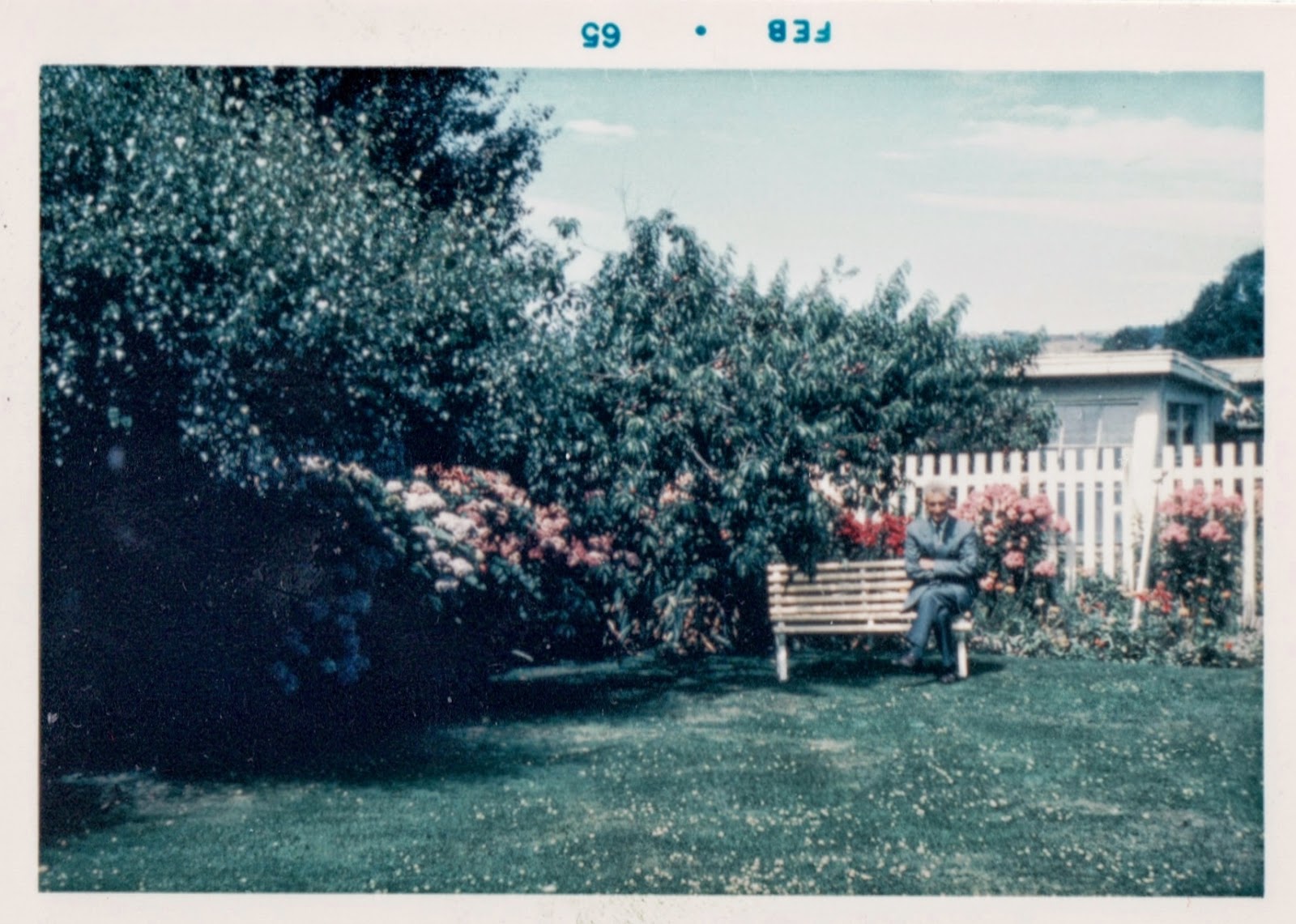
Jean's father Jack Morrison also loved gardening. I've previously featured photos of both Jack and Oliver Cruickshank weeding. Here's Jack sitting relaxing for a minute or two on a seat amongst his flowering shrubs, in February 1965, according to this helpfully dated snap.
and in the early 1970s, he's working away in his Christchurch garden with the help of two young grandchildren. Their father Peter was Jack's youngest son.
In 1976 we visited my husband's relatives on their property called Yew Tree Farm, near Hereford in England. Here are his uncle Cyril and grandmother Doris Olds {nee Newth) at work in the family apple orchard. We helped them to fill sacks with windfall apples, that would then be collected by Bulmers and made into scrumpy. The trees are still there but these days they don't really produce very much fruit.
Doris's beautiful garden that you can catch glimpses of below provided an attractive park-like setting for the very English garden party celebration of her 100th birthday in 2003, which we were lucky enough to be able to attend. Here's Doris and her #100 balloon, with great granddaughter Claire and yours truly. The shawl over Doris's shoulders was our present to her, made by yours truly, of Tunisian crochet. I made several shawls around that time but have since totally forgotten how to do it! Claire's new baby Isabelle whom we are presently visiting in London is Doris's first great great grandchild. I'm sure Doris would have loved to meet her.
Doris's park-like garden as it is today, maintained by her son Cyril
We went back to NZ on holiday last year, and I took a couple of shots of the impressive greenhouse and garden cultivated by Cruickshank descendant Helen and her husband Frank at their farm in the South Island. Helen told me that she and her husband planted out over sixty tomato plants last summer, and as a result had large quantities of tomatoes to turn into sauce, pickles and chutney for family, friends and her church stall, plus plenty of other vegetables as well.
My sister Louisa has definitely inherited the family green thumb from her father Ian, grandparents Oliver, Myrtle and Jack, and great grandfather Thomas. Here's a collage of her photos, showing scenes of bountiful produce at the community garden near Kerikeri in the far north of NZ, of which she is a member.
In return for a morning's work each week, everyone gets a substantial weekly box of vegetables to take home.
Louisa's home garden is pretty impressive too. It probably helps that she works at a garden centre several days a week. Here are a just a few shots of it, including both red and yellow sunflowers loved by the bumblebees, and my daughter Laura admiring one of them on a visit from Australia. Louisa no doubt harvests the sunflower seeds. Beautiful Monarch butterflies are regular visitors to the swan plants in her garden, as seen below.
I'll finish with an appropriate garden song from the late great Pete Seeger:
Now flit on over to Sepia Saturday 224 for more Sepian takes on this week's gardening theme.
Best wishes for a very happy Easter from the bilbies in my autumnal garden. Bilbies look a little like bunnies, but are a native Australian marsupial threatened with extinction, unlike rabbits that can quickly take over the countryside in plaque proportions, and in the process compete with the bilbie for food and habitat. For a little information about Bilbies and the campaign to 'ban the Easter Bunny', click here or alternatively go to http://www.abc.net.au/environment/articles/2014/04/14/3871404.htm?WT.mc_id=Innovation_News-Environment%7CEasterBunny,EasterSchmunny_FBP%7Cabc
This bilbie toy and his chocolate bilbie friends have travelled over to England with us, and hopefully are enjoying some early spring weather.
There are lots of photographs to be found online of workers in dangerous positions, particularly in the construction industry in the days before health and safety precautions were given any consideration, for example that iconic shot of the men working on the Rockefeller Center in 1932, which may have been staged but was still a real photograph, or one of painters on the Sydney Harbour Bridge working without safety harnesses in 1949, but as I haven't come across anyone in my own family albums looking precarious while peering down from great heights, I thought I would just offer a few photographs from the point of view of living dangerously, which can be the case even when you aren't aware that you are doing so.
This photograph shows my grandmother Mona Morrison seated on a horse in 1957 near Blenheim NZ. Both Mona and the horse look reasonably calm and happy, but appearances can be deceptive and Mona then aged 60 was no horse rider. In fact I think this may well have been both her first and last time, because the caption below the photograph reads: "Just before the horse bucked!". As a result poor Mona fell and landed painfully, suffering a back injury that would unfortunately plague her for the rest of her life. Horse riding is definitely an inherently dangerous activity, even for those who are experienced, and no doubt Mona regretted ever having agreed to try it!
My mother's family albums include numerous snaps of us children living dangerously in Canberra in the 1950s and 60s, by playing on the kind of metallic swings, slippery dips, see saws and other standard playground equipment located on hard ground, which these days are just not deemed safe for modern kids. Here are some examples:
Hang onto your hat, little brother!
That's right, hang on!
And make sure you get out at the same time, or that see-saw will topple over on the one left behind
My sister aged about 2 or 3, no doubt itching to get onto that climbing frame seen in the background
The local playground to which we were allowed to head off and play unsupervised
If you fell off and hurt yourself, you just made your own way home
Somehow we survived childhood with no broken bones and only the odd bruise or scrape!
That's it from me for a few weeks, as we are shortly off to England to make the acquaintance of our new granddaughter, but time permitting I might try to prepare a blog on the upcoming gardening prompt before I go and then post it later, as I have a few good photographs to share on that subject.
Now, take a wild ride over to Sepia Saturday 222 . Best to strap on your safety harness and helmet first though, in case there's no soft landing awaiting you!


.jpg)
+-+Copy.jpg)
+-+Copy.jpg)
.jpg)
.jpg)


+-+Copy.jpg)
+-+Copy.jpg)
+-+Copy.jpg)


.jpg)