Monday, 6 January 2020

Safe Home


Sepia Saturday #501: Safe Home

I’ve missed the call for Sepia Saturday #500  and am even a little late for a contribution to #501, but nevertheless I hope you won’t mind if I repost a blog I wrote 6 years ago at the end of 2013, the year I started to contribute to Sepia Saturday.
Here’s the link, entitled Happy Holidays, Safe Home. The main part of the blog concerned the Blue Mountains, an area in New South Wales that is popular with holidaymakers due in particular to its spectacular scenery and challenging bushwalks, The other relevance of the post was that it referred to our wedding which took place on 5 January 1974, and we have just been celebrating our 46th anniversary.
.
 I imagine that other Sepians will have heard about the disastrous bushfires in many parts of Australia that have tragically affected so many residents and visitors, whether in their home towns or on holiday. The Blue Mountains, the South coast of New South Wales and the East Gippsland area of Victoria are all popular holiday places that have have suffered in the horrifying infernos that have raged out of control for many days this summer, and the threat to them is not over yet. Lives have been lost, wildlife and stock have been killed and thousands of homes and properties destroyed. For many holidaymakers, getting safely home has been an enormous challenge, and so devastating for those residents who no longer have a home to go to.

We own a holiday unit north of Sydney in the small beachside township of Hawks Nest. I have mentioned it in other earlier blogs. Fortunately that area has not been threatened by fire this summer, but it was very smokey when we were up there before Christmas, as a result of fires slightly further north, and much of our drive  home from Hawks Nest down to Melbourne was heavily smoke affected. The smoke situation must be very much worse now.

Like many Australians, I really wonder what the future holds, and glib political platitudes certainly don't provide us with any solutions. Perhaps it's time to re-think the annual Christmas holiday by the beach, but for now I can only wish all holidaymakers a safe trip home, help for all those who so badly need it, and for everywhere else, smoke-free skies and lots of very much needed rain!

My late father-in-law fishing and camping, c 1948

Family camping holiday at Lake Tabourie on the NSW South Coast, early 1960s.

This photo was taken by my brother of the fire across the lake from his home. He and his wife evacuated to a safe location and thankfully the fire did not reach their home town.

Smoke blankets Central Melbourne, 3 January 2020

Safe Haven: Bayside view, Hawks Nest NSW
To read other Sepian members’ blogs, just click here and be transported to the smoke-free safe haven of  Sepia Saturday.

Sunday, 1 December 2019


A Study in Concentration 2

I haven’t blogged for close to 18 months now, sad to say, and have definitely got out of the habit of contributing regularly, mainly because I found I was lacking inspiration and also running out of photos in my family collection that I hadn’t already included in previous contributions. I was also having a few problems with blogger.com.  I was texting with Marilyn B aka Little Nell today however and then just happened to check the SS page today and thought of a good match for the topic photo that I could add. Like  most of my photos, it has been shown before, but that was back in 2014, so I don’t imagine anyone would remember it. I have used the same heading for an earlier blog too, hence the 2, but at least it was not for the same photo.
 My father Ian Cruickshank would have been around 40 or 41 at the time it was taken. Dad had discovered and chemically identified the phytoalexin which he named Pisatin in 1962. It was his main claim to fame in the scientific world. Pisatin was important in relation to the study of plant diseases, which was his area of research for almost 40 years of his working life.  I remember he would be off to the lab at all hours of the night to check on his pea experiments. He passed away in 2000, and now his granddaughter/my eldest is turning 40 early next year. Hard to believe!
Dad now has 9 great grandchildren, and no doubt would be pleased to know that youngest of them is his namesake, little Michael Ian, who is just 8 weeks old.


Here's Ian with Michael Ian's mother in 1987.

Anyway, hello to my old Sepia Saturday friends, who unlike me have not stopped blogging. You can find their contributions to this week’s topic here at Sepia Saturday 498.


Thursday, 7 June 2018

On the Beach


The Sepia Saturday image above was taken at Bridlington in East Yorkshire in 1922 and shows a couple in their deckchairs on the beach. Something ressembling a towelling coat is draped over one of the chairs although it seems unlikely that the occupant of the chair has been swimming or is about to do so. As often is the case with English beaches, the water is nowhere to be seen, and the tide was very likely a long way out, a phenomenon that generally does not occur on Australian beaches, or at least not in the Southern states.

My first photo below was taken on thed beach at Malua Bay in January 1991 and shows a lineup of cousins, namely the eight grandchildren of Bob and Mary Featherston. My husband and the father of four of the children can also be seen in the photo, and I think Bob Featherston appears in another shot with the children that I don't seem to have.  The children, their parents and grandparents were all staying in or around  the family beach house at Malua for a few days after Christmas. I've posted before about the beach house and if you click here you can see that it is not very big!


I think this was possibly the only time that we were all at Malua together, and there have not been very many occasions since then when all the cousins have gathered, other than very occasionally at Christmas when they were still young. Now two of the eight live with their families in London and the others are scattered around Australia. Seven attended at a wedding of the cousin on the far right two years ago. Their grandfather Bob passed away just over a year after the beach lineup photos were taken, and I believe the photo with him is one of his wife Mary's favourites. I don't know what the grey square in the middle of the photo is, but perhaps it was an indication on the pre-digital film that the end of the roll had been reached.


Above is the father of 4 reading on the beach in January 2017, at Winda Woppa on the mid-north coast of New South Wales. We were enjoying the peace and quite after a hectic visit by our English grandchildren, whose mother is in the pink and white polka dot costume in the photo above,  You may think this photo is cousin-free, but in fact the book he is reading was written  by his American 4th cousin Clayton Swisher. Clayton whom we had recently met lives in Doha and works for Al Jazeera English and the title of his book is The Truth about Camp David. It's an interesting read.


My third photo is perhaps the most similar to the Sepia Saturday prompt, and was taken at Lyme Regis, in Dorset in September last year. At least you can see the water here, but although it looks sunny it was windy and inclined to showers whenever the sun disappeared behind the clouds. While the couple in the deck chairs here are sunning themselves with their eyes shut, we were wearing our coats! It all depends what you are used to, I guess.

It's winter here in Australia and the weather is not very beachy,  but last weekend at my favourite Hawks Nest beach I still managed to catch some nice views and even caught a rainbow in the early morning.


For more beach reflections check out Sepia Saturday #422

Comments (deleted in error but all except one copied and reposted here)


Friday, 25 May 2018

Beside the Seaside #2


Lately I seem to have become a rather infrequent contributor to Sepia Saturday, partly because I've been busy doing other things and partly because a number of recent photographic subjects seem to have been covered previously and my source of old family photos that I haven't already used in blogs is sadly coming to an end. This week however I’m posting for the first time in few weeks. I've called it Beside the Seaside # 2 because I have posted on the topic before, as you can see here. 

The Sepia Saturday prompt is of the scenic railway at or near Venice Beach California. It was demolished in 1920 to make way for a big dipper, which also no longer exists. We spent a few hours at Venice Beach in 2005, filling in time after our flight to Washington DC was delayed for most of the day following a bird strike. I don't remember seeing any kind of funfair activity, but I do remember lots of inline skaters and volleyball players, as well as well tanned beach goers.

Here in Australia we don't generally associate donkeys or side show alleys with beaches. Our beaches are simply places where people go to enjoy the surf, sun and sand, but one possible exception to this general rule here in Melbourne is Luna Park in the bayside suburb of St Kilda. It's not quite on the beach like the one pictured in the prompt, but is only only a short stroll away, and has been operating almost continuously since 1912, which makes it  the world's oldest roller coaster still running. Both the Face of Luna Park and its Scenic Railway are heritage listed. Here is a Youtube clip which gives you an armchair virtual ride, plus good views of Port Phillip Bay and surrounds. We go to St Kilda and nearby beaches year round, although often it is just to walk rather than swim, and have often walked past and occasionally through the Luna Park grounds. I’ve never been inclined to ride the Scenic Railway myself but am always amazed how the brakeman standing between the two cars looks to be barely holding on. If he or she were to somehow lose control it would not be good! Apparently there are only three rollers coasters worldwide where brakemen like this are still required.


If you want to read about the history of Melbourne's Luna Park, click here.

I'm sure I must have some of my own photos of the Luna Park Face, but I can't locate them right now, so instead here are several models of this Melbourne icon, one made in Lego, one in sand and one in gingerbread, made by some very clever people. I just took the photos.


Back in December 1992 we caught a ferry from The Netherlands across to the UK and the children had their first experience of seaside piers on both sides of the Channel. The weather in Schveningen was bleak, damp and cold and there were very few people about. The sign on the tower says OPEN but I'm pretty sure it was not. Here are a couple of family photos of that visit.


A few days later, about a week before Xmas, it was a much brighter day in Brighton England, but again seagulls were our main companions on the Brighton Pier. No doubt it is bustling with both tourists and locals at this time of  year, but it's not my kind of fun.


 I much prefer my beaches and piers  to be unadulterated with such attractions, so I'll finish with a photo of my favourite beach at Hawks Nest New South Wales, where we are lucky enough to have owned a holiday unit for the last twenty years now, We don't manage to get up there very often but when we do it's always a relaxing break, summer or winter. In fact we will be up there for a couple of days next weekend. Looking forward to it!


For more blogs prompted by this week's Sepia Saturday image, click here.

Friday, 13 April 2018

What's in that wheelbarrow?


This week's Sepia Saturday prompt reminds me of the old song about Molly Malone, who "wheeled her wheelbarrow, through streets broad and narrow, crying cockles and mussels, alive alive O! " Other Sepians may very well have already referred to this, and I really don't have anything comparable, but I did find a few wheelbarrows wandering through family albums old and new.


This first photo shows my brother and sister in the garden in the early 1960s. It looks like that's a load of leaves that my sister is perching on. Our Dad was a very keen gardener.


Fast forward about twenty years and above  you see our older son on Christmas Day with the wheel barrow and a load of other gifts he had received for Christmas. In the next photo he's trying it out in the garden with his Dad.


It's still popular a bit later, although again there's nothing actually in it. It was made of solid pine and I wish we still had it for visiting grandchildren, but of course you can't keep everything.


Below are our English grandchildren recently with their Dad's wheelbarrow, supposedly looking for worms, but it was at Easter time and I think an egg hunt may have also been happening in the back garden at the time.


And where do old wheelbarrows go when they are retired? They still have their uses, as you can see below.


For more blogs from fellow Sepians based on this photo prompt, just wheel your wheelbarrow over to Sepia Saturday

Friday, 16 March 2018

Have Umbrella, Will Unicycle ...


The Sepia Saturday prompt this week features umbrellas, children, a policeman and a dark night. It's still quite warm and summery here in Aus, with 33° C expected today and we haven't had any significant rain for several weeks. This is really the only photo I can think of that fits the bill, vaguely at least. Our son Kim who was then aged about 12 was showing off his unicycling skills in our driveway, back in the mid 1990s, and wrote this sweet poem to go with this photo that I took of him. I had developed it myself after converting our windowless internal ensuite into a makeshift darkroom. I eventually stopped using the ensuite for developing, but the chemical odours lingered for a long time afterwards and must have mystified the buyers of the house some years later.


He's not much inclined to unicycle some 20 years later, but no doubt he still can. After all it's just like riding a bike, I believe! One of the children's old unicyles is rusting away in our shed while another is kept up at our beach house and our teacher daughter occasionally gives her young school students a demonstration.

For more contributions to Sepia Saturday, click here.

Saturday, 17 February 2018

Memorial Weekend


My father-in-law Robert Featherston passed away on 16 February 1992 and my own father Ian Cruickshank died eight years and one day later, on 17 February 2000. Coincidentally my father was eight years younger than my father-in-law, so Bob was 74, Dad was 75 years old when they died. It's quite a long time ago and not something I often think about, but there it is. I've blogged about both of them numerous times previously, herehere and here in relation to my Dad, and herehere and here in relation to Bob for example, so I'm not going to do any more than post a couple more photos of them that are vaguely on theme with our Sepia Saturday prompt photo this week, which shows a number of young swimmers standing on or hanging off a diving tower at a Brisbane pool.
There is a similar tower at the Eastern Beach swimming enclosure at Geelong, which also features in my last link, entitled Swimmers with Arms Folded. I don't have many photos of either Bob or Ian clad in their swimming costumes, other than the one of Bob in that post, but here he is relaxing in a river somewhere in 1947.


And here is my tall slim Dad strolling along a sandy beach in the 1960s:


        RIP Bob and Ian. We'll raise a glass to them both.

Now here are a couple of family snaps of children pretending to be on diving towers, which seems to have been a popular thing to do in our back yard when the paddling pool came out on a warm summer's day. I'm standing with a friend in the first photo and then apparently defying gravity in a tussle with my brother in the second one.


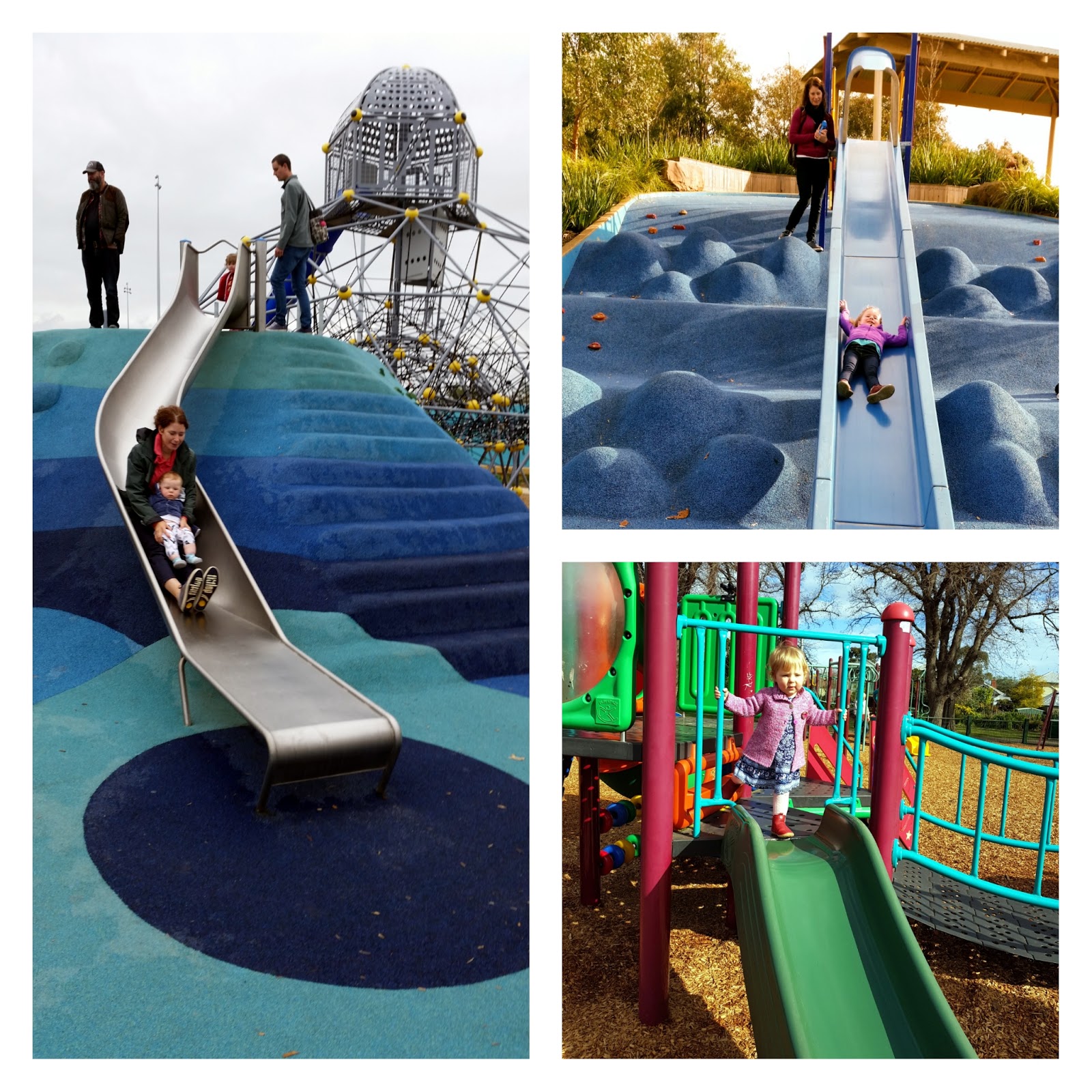
And one more of my brother and sister up a different kind of ladder, the slippery dip at our local playground. Hopefully they did not try to jump off! This was in Canberra in the 1960s. Now we live in Victoria, where slippery dips are rather less imaginatively known as slides, but I'm doing my best to teach my grandchildren the 'correct' term.😀


                      Anyone fancy a slippery dip?


For more blogs possibly featuring towers ladders, swimmers and related subjects, please visit Sepia Saturday #406.

Saturday, 10 February 2018

Under the Jacaranda


I was just looking at the prompt photo again and the fact that it is in a garden and comes from Queensland suddenly brought to mind this oil painting that I loved seeing last year when I visited the Art Gallery of Queensland in Brisbane. It was painted in 1903 by English immigrant R. Godfrey Rivers and depicts the painter and his wife Selina being served an elegant afternoon tea under a spectacular jacaranda tree in full bloom. They may well have been acquainted with John Nicholson and his wife Anna, as they lived in the same city around a similar time period.  According to a former curator of the Brisbane Botanic Gardens, this tree was planted there in 1864 and was the first jacaranda to be grown in Australia, from seeds obtained from a visiting South American sea captain. Click here for more information about the history of this tree. It was blown down by a storm in the 1980s but many jacaranda trees in the Brisbane region have been grown from cuttings and seeds originally  taken from it. 


Jacaranda season in Australia runs from October to December, depending on the location. They are not as prolific down here  in Melbourne as they are in Sydney and cities and towns further north, but I took this photo locally in December last year. Purple has always been my favourite colour! There's an Australian magpie enjoying it too.


Happy Valentine's Day!

Friends for life


This week's Sepia Saturday image shows a married couple talking over a cup of tea.  

I don't have anything similar really, but I do quite like this snap of my mother Jean and her good friend Colleen sitting together in front of the fireplace. Jean is knitting and Colleen is also doing some sort of handwork, perhaps sewing. They were both aged about 20. The photo is rather out of focus, possibly because whoever took it didn't have flash on their camera, but that doesn't detract from the relaxed and companiable atmosphere that is shown to exist between these two ladies, and nor did it deter Jean from including it in her album.


Colleen and Jean met as college students in Auckland New Zealand in the 1940s and remained friends for the rest of their lives, despite Jean subsequently moving to Australia. They both married and had three children. Coincidentally both ladies died in 2014 within a few months of one another, aged 87. 
To finish, here is a happy photograph of three ladies around Jean's dining table 60 years later in 2006, celebrating her 80th birthday. Colleen is on the left and the lady in the middle is Betty, a friend of Jean ever since school days. Cups of tea and cake all round!


RIP Colleen and Jean.
 Their friend Betty is still going strong.

Friday, 19 January 2018

Byles Family plot at Karori


When I looked at the prompt photo for Sepia Saturday this week I initially thought the dark shapes were nuns walking amongst the graves, but then realised they were trees. It looks like a small, neat cemetery layout, unlike many that I've visited in the past, while searching for graves of family members. Often those searches have proved futile, with the person apparently having no headstone, just an unmarked grave that I may or may not have managed to pinpoint somewhere.  

Karori Cemetery in the hills of Wellington NZ is large, covering over 40 hectares and being the last resting place of more than 83000 souls. I went there by bus and am not sure now whether or not I was able to ask directions at the office but I had a grave location and map and surprisingly enough was able to discover the family plot for my Byles great grandparents Mary Ann and Thomas Alfred Byles and their oldest daughter Ellen Mary, known as Nellie or Nell. Nellie died first aged only 29, and according to my aunt this was because she was broken hearted after her fiance was killed in WW1. Her mother Mary died 3 years later aged 54. Thomas survived his wife Mary by 27 years and is buried here with them.
 My grandmother Myrtle May was the nextborn child of Mary and Thomas. She died in Rangiora in 1959 but both she nor her husband/my grandfather Oliver Cruickshank who died in 1985 were cremated and do not have memorial plaques, so I was happy to be able to pay my respects to Myrtle's parents and sister there by their graveside. I was also glad to leave because the weather was threatening and because it felt rather an isolated place late in the afternoon where you wouldn't want to meet any unsavoury characters. It can also be quite sad reading the heartfelt memorials even when you have no connection to the people, particularly if they are for young children or babies.

Mary, Beloved Wife of Thomas Byles, died 11th Oct. 1924, aged 54 years
Thine Forever, God of  Love
Nellie, Beloved daughter of Thomas and Mary Byles
who fell asleep on 14 June 1920, aged 29 years
There is a link death cannot sever
Sweet Remembrance Lasts Forever


Thomas A Byles ,
Beloved husband of Mary
Passed away 12th March 1951
At Rest

Byles family plot


http://mp.natlib.govt.nz/detail/?id=36283
The photo above from the National Library of NZ shows people laying wreaths on ANZAC Day, 25 April 1921, less than a year after Nell died.

Marriage announcement for Thomas and Mary Ann in the Evening Post, April 1889.


I've posted about Thomas Byles before, for example here, in relation to the fact that I haven't yet been able to discover any documentary evidence to prove or disprove the family story that he arrived in New Zealand after having been discovered to be a stowaway in the late 1870s, but finding the Byles family plot was certainly a lot better than discovering during the same trip that his wife Mary's grandmother, Jane Key nee Berry, had been buried in the Bolton Street Cemetery in Wellington but that her remains had been dug up to make way for a motorway and the remains deposited in a common grave, together with over 3000 others. At least her name is recorded here.  


For more blogs on this week's prompt, go to Sepia Saturday #402